


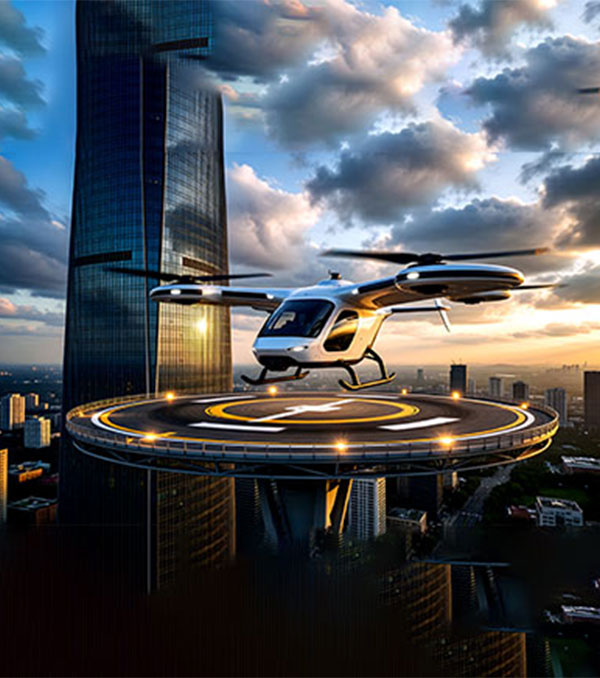
Powering India’s First Indigenous eVTOL
Tata Elxsi and Sarla Aviation join forces to accelerate the development of Shunya, advancing the future of urban air mobility.
Read Press Release

Tata Elxsi and National Aerospace Laboratories
MoU for Advanced Air Mobility and Accelerate Innovation in UAVs, UAM, and eVTOLs for Global Markets.
Read morePowering the Roadmap to Sustainable Aviation
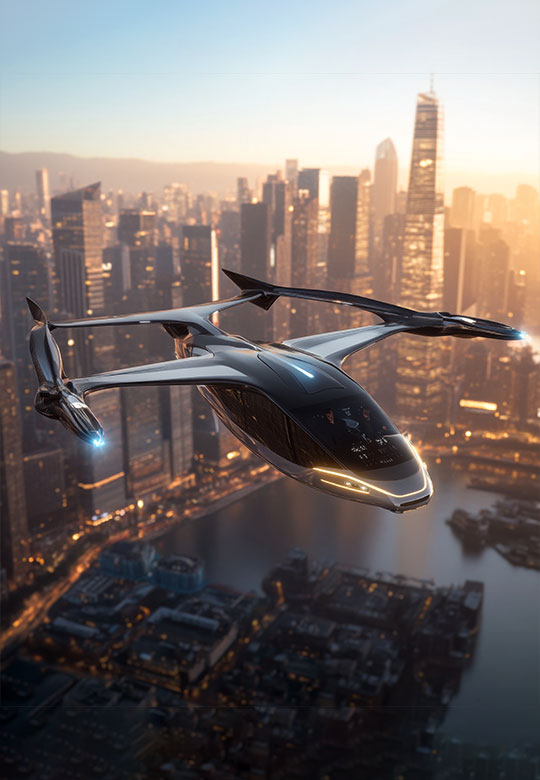
In an era of heightened environmental consciousness, the aerospace industry is accelerating its transition towards electrification and advanced air mobility. Through electric propulsion, advanced battery systems, integrated power electronics, and intelligent energy management, organizations are developing next-generation aircraft that reduce emissions, improve operational efficiency, and enable new modes of transportation. Hybrid-electric aircraft, electric vertical take-off and landing (eVTOL) platforms, and innovative flight concepts are driving the future of sustainable aviation across commercial, urban mobility, and defense sectors.
At Tata Elxsi, we collaborate with global aviation leaders and emerging advanced air mobility innovators to engineer electric aircraft and eVTOL platforms. From battery management systems, thermal management, and flight-critical avionics to testing, certification, and ground infrastructure engineering, our expertise accelerates the development of safe, efficient, and certifiable aviation solutions for a sustainable aerospace ecosystem.
Here’s How We Can Help You
End-to-End Design & Engineering
- Concept-to-certification engineering for electric aircraft, hybrid-electric aircraft, and eVTOL platforms.
- Battery Management Systems (BMS), power electronics, thermal management, flight controls, and avionics software engineering.
- Advanced modelling, simulation, and prototyping to accelerate innovation while ensuring safety and performance.
- Turnkey aerostructure design, cabin interior engineering, passenger experience enhancement, and sustainable lightweighting solutions for next-generation aircraft.
Systems Integration & Validation
- Integration of battery systems, electric propulsion, avionics, flight control systems, and vehicle management systems.
- Hardware-in-the-Loop (HIL), Software-in-the-Loop (SIL), and integrated test systems for safety-critical validation.
- Verification and validation services to reduce program risk and accelerate certification readiness.
Regulatory Compliance & Certification Support
- Compliance support for DO-178C, DO-254, DO-160, and DO-330 certification standards.
- Requirements-based testing, environmental qualification, certification documentation, traceability, and airworthiness support.
- Expertise in supporting certification of next-generation electric aircraft and eVTOL programs.
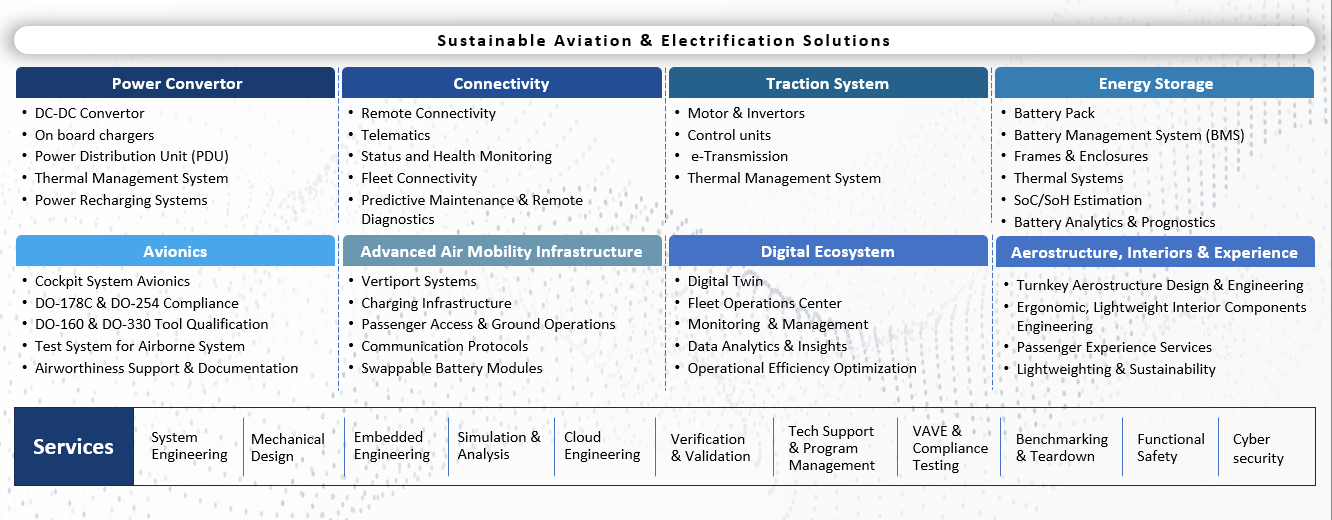
Solution Framework
Holistic Engineering Approach
We bring together expertise in electrification, battery systems, power electronics, thermal management, avionics, and flight-critical engineering to develop electric aircraft, Advanced Air Mobility (AAM), and eVTOL platforms. Our multidisciplinary teams deliver safe, efficient, and certifiable aviation solutions across the sustainable aviation ecosystem
Digital Twinning & Simulation
Leverage digital twins and simulation models to evaluate battery systems, electric propulsion architectures, thermal performance, and operational scenarios. This enables faster design iterations, reduced development risks, and accelerated time-to-market.
Advanced Validation Infrastructure
Comprehensive verification and validation through Hardware-in-the-Loop (HIL), Software-in-the-Loop (SIL), environmental testing, and system integration labs. Our validation frameworks support certification readiness, reliability, and compliance with aerospace standards.
Why Tata Elxsi?
- Proven expertise across aerospace, electrification, embedded systems, and software-defined engineering.
- End-to-end capabilities spanning battery systems, power electronics, thermal management, avionics, and flight controls.
- Strong experience in safety-critical aerospace systems, verification & validation, and certification support.
- Advanced engineering labs, HIL/SIL frameworks, and digital engineering accelerators for faster product development.
- Leverages deep expertise in automotive electrification, software-defined vehicle, and safety-critical engineering, now enabling next-generation electric aircraft, Advanced Air Mobility (AAM), and eVTOL platforms.
- AS9100D-certified engineering processes, ensuring quality, traceability, and compliance for aerospace and defense programs.
- Global delivery experience supporting OEMs, Tier-1s, airlines, and emerging aerospace innovators.

Information Hub
-
What is driving the demand for aerospace electrification?
Global environmental mandates, rising fuel costs, and technological advancements have converged to spark interest in aerospace electrification. Airlines and manufacturers seek ways to minimize emissions and operating expenses, prompting investments in electric propulsion and hybrid-electric systems. Additionally, consumer awareness and government incentives accelerate the push for sustainable aviation. As urban air mobility and eVTOL concepts gain momentum, the industry sees electrification not just as an eco-friendly measure but as a strategic imperative to remain competitive in a evolving market.
-
How do hybrid-electric aircraft differ from fully electric planes?
Hybrid-electric aircraft combine traditional turbines or engines with electric propulsion, allowing partial electrification of flight segments. This approach reduces fuel consumption and emissions while maintaining range and power reliability. In contrast, fully electric planes rely solely on battery technology for all flight operations, which currently limits range and payload capacity. Hybrid-electric designs provide a balanced solution, leveraging existing infrastructure and easing regulatory approval. They also serve as a bridge toward fully electric models by enabling incremental adoption of sustainable aviation practices within today’s operational constraints.
-
What are the major challenges in implementing electric propulsion?
Key hurdles involve battery technology energy density, power electronics cooling, and the added weight of electric drive systems. Limited battery capacity restricts flight range and payload, while thermal management for high-power components remains complex. Additionally, infrastructure for electric propulsion—including charging stations and grid capacity—must be upgraded to accommodate widespread adoption. Regulatory guidelines and rigorous safety testing also shape development timelines. Overcoming these challenges requires ongoing research, innovative material science, and engineering breakthroughs to ensure electric propulsion solutions can compete with conventional aviation alternatives.
-
When will we see widespread adoption of sustainable aviation technology?
Timelines vary as factors like regulatory guidelines, infrastructure readiness, and market demand shape the evolution of sustainable aviation. Some industry forecasts project commercial hybrid-electric aircraft to enter service within the next decade, while fully electric regional planes may take longer. Government incentives and climate policies are accelerating research and development, fueling more prototypes and test flights. As battery technology advances and power electronics become more efficient, the tipping point for widespread adoption will likely occur once cost, range, and reliability align with industry and passenger expectations.
-
How do next-gen battery technology and power electronics impact future aircraft design?
Next-generation battery technology aims to improve energy density, reducing the weight penalty and increasing range for electric propulsion aircraft. These batteries often integrate advanced cooling and management systems to handle high power loads safely. Meanwhile, cutting-edge power electronics enhance efficiency by regulating voltage, current, and thermal profiles in real time. This synergy enables more compact components, lighter wiring, and improved performance across hybrid-electric or fully electric platforms. As a result, aircraft can achieve longer flight durations, lower operating costs, and significantly smaller carbon footprints.