

Tata Elxsi and KAVIA AI Forge Strategic Partnership, bringing GenAI Powered SDLC Automation to Enterprises
Read Press release

Tata Elxsi & Sky Advance AI-Led Autonomous Network Transformation with NEURON
Read Press Release

Tata Elxsi and OpenAna Launch AnaTel™, an AI-Native Software Development Platform
AnaTel™ helps medical device and SaMD companies accelerate software development, generate regulatory-grade documentation, and reduce development cycle times
Read Press ReleaseAI-Powered, Design-Led Software Engineering
Most enterprises are not short of engineering capacity. They are short of engineering leverage. Investment rises, headcount grows and delivery still slows as fragmented workflows, legacy complexity, quality issues and security controls create friction across the software lifecycle. AI is changing this equation, moving beyond code completion to support discovery, architecture, development, testing, modernization and operations. Yet adoption alone does not create value. Sustainable gains come when human expertise and AI work within a redesigned engineering system, supported by trusted context, secure guardrails, reusable platforms and continuous measurement of speed, quality and developer experience.
Tata Elxsi engineers this shift through a design-led, AI-native operating model for software delivery. Our services bring together product and experience design, cloud-native application development, application modernization, quality engineering, DevSecOps and managed platform operations, with AI embedded across each stage of the lifecycle. We combine engineers, domain specialists and AI-enabled workflows to accelerate validated learning, reduce hand-offs and improve delivery consistency, while maintaining human oversight, security, compliance and architectural integrity. Backed by decades of ER&D heritage, we build and continuously evolve products and platforms, not just implement software.
A Portable Diagnostic Platform Offering Affordable and Accessible Care


Business Challenge
Software has become the primary driver of customer experience, business agility, and competitive differentiation. Yet many organizations struggle with legacy systems, fragmented platforms, siloed development teams, and inefficient delivery processes. Technical debt, limited automation, and inconsistent engineering practices make it difficult to accelerate releases, adopt AI-driven innovation, modernize applications, and operate secure, resilient, and scalable digital products at enterprise scale.
Here's how we help
Design & Build
- Discovery, consulting and target architecture
- Product and application engineering, including GenAI applications, copilots and enterprise assistants
- Legacy modernization and cloud transformation through AI-assisted engineering, API-first integration and reusable services
Assure & Secure
- Quality engineering and test automation with AI-driven test generation and defect prediction
- Security testing and DevSecOps controls
- Performance engineering, resilience validation and responsible AI governance with compliance-ready documentation and guardrails
Run & Evolve
- SRE-led platform operations and observability, with AIOps anomaly detection and root-cause analysis
- Release management, incident response, SLA governance and auto-remediation
- Agentic workflows and intelligent automation across engineering, operations, document, decision and exception handling for continuous optimization
Software Engineering Services
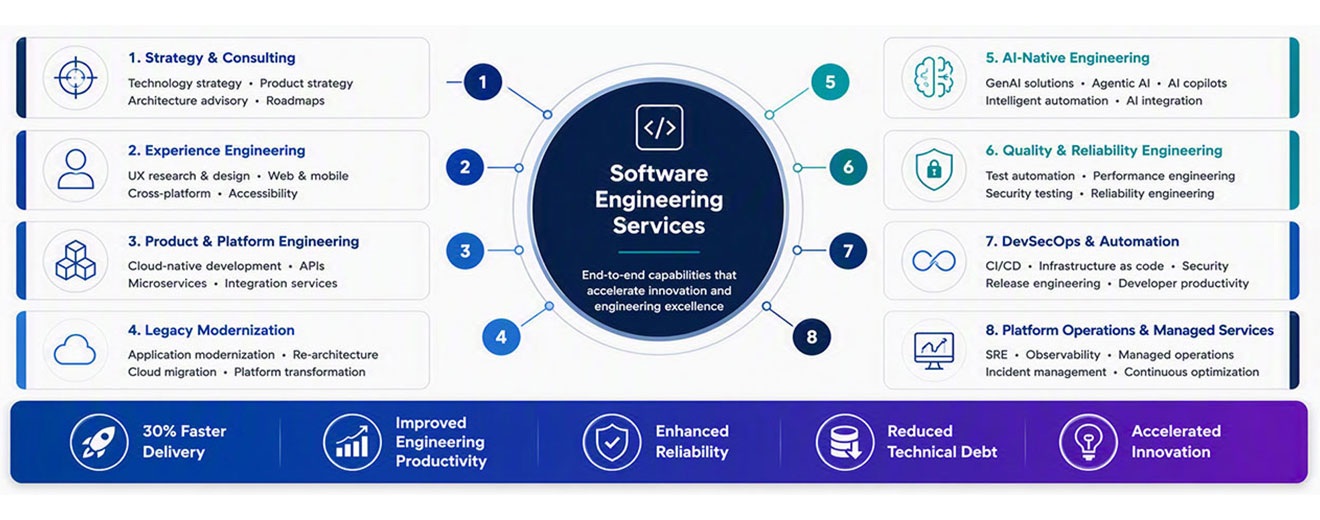
Tata Elxsi’s software engineering services bring eight connected capability families together across the full software lifecycle. From technology strategy and experience design through cloud-native build, modernization and AI-native engineering to quality, DevSecOps and managed platform operations, each family is delivered through the same design-led ER&D practice. The approach is designed to improve delivery speed, engineering productivity, reliability and modernization outcomes while reducing technical debt.
Software Engineering Services
Design-led software engineering
We start with customer and user needs. Discovery, experience design and target architecture shape the product strategy and modernization roadmap, then UX, web, mobile and cross-platform engineering turn that intent into scalable products.
Cloud-native development and modernization
Most modernization stalls because it's run as a migration, not as engineering. We build reusable platform capability; cloud-native development, APIs, microservices, integration and re-architect, migrate and transform to retire legacy for good, with GenAI and intelligent automation running through both.
Quality engineering, DevSecOps and managed operations
Platforms rarely fail on day one; they degrade when observability isn't built in. Test automation, performance and security engineering prove quality before release; CI/CD and infrastructure as code make delivery repeatable; SRE, observability and managed operations keep platforms evolving after go-live.
Why Tata Elxsi?
- Engineering intelligence, design leadership, domain depth: 37+ years of ER&D heritage connecting customer experience, product engineering and industry context across Mobility, Media and Communications, Healthcare and Enterprise platforms, turning business priorities into products built to scale and evolve.
- AI-powered engineering: AI embedded across discovery, architecture, development, modernization, testing and operations, not bolted on. Human oversight, secure guardrails and domain context turn AI productivity into consistent quality and responsible innovation.
- Proven accelerators: TE-Prompt, AI Glass, TEDAX Nexus, DevStudio.ai, IRIS and AIVA compress time-to-value.
- Design-led engineering: Customer experience drives product decisions, with design built into engineering rather than layered on afterwards.
- Strategic technology ecosystem: Partnerships with KAVIA AI, AWS, Microsoft Azure, Google Cloud and Red Hat to accelerate transformation at scale.
- Lifecycle ownership beyond launch: Cloud-native architecture, DevSecOps, SRE, observability and managed operations keep platforms secure and adaptable, with production insight feeding back into engineering to cut technical debt and sustain value.
In Focus






Information Hub
-
Which capabilities does Tata Elxsi bring together across the software engineering lifecycle?
Eight connected capability families span the lifecycle: Strategy & Consulting, Experience Engineering, Product & Platform Engineering, Legacy Modernization, AI-Native Engineering, Quality & Reliability Engineering, DevSecOps & Automation, and Platform Operations & Managed Services. Together they form end-to-end capabilities that accelerate innovation and engineering excellence across the software lifecycle.
-
How does Tata Elxsi integrate experience design, domain expertise and architecture into software delivery?
Tata Elxsi brings decades of design-led ER&D heritage — building products and platforms rather than only implementing software — with international design recognition for its UX work. Experience Engineering sits as a first-class capability family covering UX research and design, web and mobile, cross-platform delivery and accessibility, alongside UX/CX specialists.
-
What outcomes has Tata Elxsi delivered through software engineering engagements?
Tata Elxsi's software engineering engagements are designed to improve delivery speed, engineering productivity, reliability, modernization outcomes and operational efficiency. Our Case studies span reduced operating cost, faster incident resolution and significant test-effort savings. Results are engagement-specific and depend on the starting environment, scope and agreed measurement baseline.
-
How does Tata Elxsi approach AI-native software engineering?
GenAI, agentic AI, AI copilots, intelligent automation and AI integration are embedded across the SDLC - intake, analyze, design, build, assure and release - with engineer oversight and enterprise guardrails at each step. This is backed by extensive AI engineering experience, a growing AI patent portfolio, a KAVIA AI partnership and Responsible AI guardrails.
-
How does Tata Elxsi enable product localization and market entry?
Through our Value Analysis & Value Engineering (VAVE) services, we optimize products for regional requirements—be it localization, regulatory adaptation, or cost engineering. Combined with our multi-region delivery centers and local partner ecosystem, we help clients scale faster across new markets while maximizing ROI and product differentiation.
-
How do you handle legacy application modernization?
Through application modernization, re-architecture, cloud migration and platform transformation. Modernization programmes are typically run in phases: audit, modernization and operationalization; delivering lower operating cost, faster incident remediation through AI-based automation, and conversion of manual workflows to low-code automation. Actual outcomes depend on the estate, scope and agreed baseline.
-
What does quality engineering and DevSecOps include?
Test automation, performance engineering, security testing and reliability engineering, plus CI/CD, infrastructure as code, security, release engineering and developer productivity. Delivered solutions have generated test cases from tickets, requirement documents, URLs and images with duplicate detection and coverage reporting, achieving high accuracy and substantial test-effort savings.
-
What do managed platform operations cover after go-live?
SRE, observability, managed operations, incident management and continuous optimization under SLA governance. Managed-operations engagements have reduced effort in report generation and incident management and lowered extended-support cost, supported by an AIOps layer for auto-diagnostics and remediation across work-streams.