


Tata Elxsi and National Aerospace Laboratories
MoU for Advanced Air Mobility and Accelerate Innovation in UAVs, UAM, and eVTOLs for Global Markets.
Read moreRevolutionizing the Sky
As the global adoption of Unmanned Air Systems (UAS), Unmanned Aerial Vehicles (UAVs), and autonomous drone platforms accelerates, aerospace and defense organizations face growing pressure to develop scalable, intelligent, and mission-ready solutions. Advanced technologies such as AI-driven autonomy, sensor fusion, flight control systems, and digital engineering are becoming critical enablers of next-generation unmanned operations. At the same time, evolving airspace integration requirements, BVLOS operations, and regulatory frameworks are driving the need for robust, certifiable, and secure unmanned aviation solutions.
At Tata Elxsi, we help aviation and defense innovators realize the full potential of unmanned systems through end-to-end engineering services spanning UAV design and development, avionics, software, validation, certification, regulatory compliance, and lifecycle support. Our deep aerospace expertise enables customers to enhance mission effectiveness, reduce program risks, accelerate time-to-market, and unlock new opportunities across commercial, defense, surveillance, and autonomous air mobility applications.
.jpg )
.jpg )
Here’s How We Help
Strategic Consulting
- Assess operational requirements and identify high-value UAS/UAV applications across commercial, defense, surveillance, reconnaissance, border security, intelligence-gathering missions and autonomous aviation use cases.
- Develop drone adoption roadmaps, certification strategies, and regulatory compliance frameworks aligned with evolving airspace, security, and BVLOS requirements.
Engineering & Prototyping
- Design and develop advanced UAV platforms, including airframe engineering, avionics, flight control & management systems (FCS/FMS), advanced sensor integration and battery management systems (BMS).
- Build rapid prototypes and perform simulation, testing, verification & validation, and performance optimization to ensure reliability, safety, and certification readiness.
Deployment & Lifecycle Support
- Enable seamless deployment through integration with Ground Control Stations (GCS), mission management systems, command & control networks, ISR platforms, and existing operational infrastructure.
- Provide predictive maintenance, cybersecurity, fleet monitoring, and data-driven optimization to maximize performance, availability, and mission success.
- Deliver end-to-end lifecycle support, upgrades, sustainment, and scalability services for evolving unmanned aviation programs.
Solution Framework
Advanced Autonomy
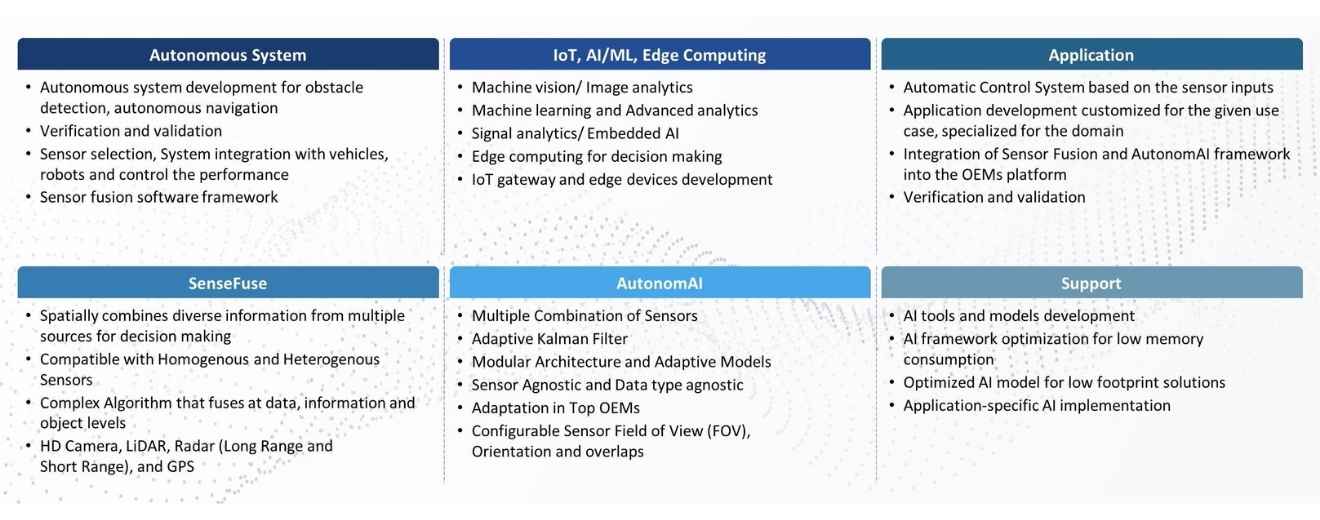
Leverage cutting-edge algorithms and sensor fusion for real-time obstacle avoidance, intelligent path planning, and mission adaptation. Our solutions ensure reduced human oversight while maintaining impeccable reliability, enabling dynamic in-flight decisions that optimize energy usage, flight routes, and payload management—all designed to scale seamlessly across diverse operating environments and mission success.
Real-time Data Intelligence
Empower data-driven insights through high-fidelity sensor data aggregation, analysis, and visualization. Our integrated platform monitors flight parameters, environmental conditions, and system health, enabling predictive analytics for proactive maintenance. This holistic approach captures actionable intelligence that significantly refines flight performance, lowers operational costs, and maximizes the overall value of unmanned deployments.
Regulatory Compliance & Safety
Stay ahead of evolving airspace regulations with meticulous compliance strategies, risk assessments, and certification support. We integrate advanced redundancy protocols and fail-safe mechanisms that protect both operators and payloads. By proactively addressing safety from concept to deployment, our solutions foster trusted adoption, unwavering confidence, and ultimately streamlined regulatory approvals globally.
Why Tata Elxsi?
- End-to-end UAS engineering across UAV design, avionics, flight controls, certification, and lifecycle support.
- Deep aerospace and defense expertise for commercial drones, autonomous systems, and mission-critical UAV programs.
- Proven digital engineering, system integration, and V&V capabilities that reduce risk and accelerate time-to-market.
- Strong focus on airworthiness, cybersecurity, safety, and regulatory compliance for certification-ready solutions.
- Expertise in AI-driven autonomy, sensor fusion, and mission systems for next-generation unmanned operations.
- Global delivery model with scalable execution and localized customer support.

Information Hub
-
What are the emerging trends shaping the Unmanned Air Systems market?
Key trends include the integration of AI-driven analytics, advanced materials for lightweight design, and BVLOS (Beyond Visual Line of Sight) capabilities for expanded operational reach. Additionally, 5G and satellite connectivity are streamlining data transfer, while enhanced autonomy solutions minimize pilot intervention. These factors collectively enable UAS to undertake complex missions such as cargo delivery, infrastructure inspection, and search-and-rescue. With regulatory bodies increasingly supporting commercial drone operations, the market is witnessing rapid innovation in sensor fusion, swarm intelligence, and multi-platform interoperability.
-
How does Tata Elxsi address regulatory compliance for commercial drones?
We stay ahead of evolving compliance mandates by actively engaging with aviation authorities and standards organizations worldwide. Our experts monitor policy changes, ensuring UAS designs and operational protocols align with national and international guidelines. This includes robust safety assessments, documentation, and certification support for flight clearances. Beyond meeting regulatory requirements, we implement advanced geo-fencing, fail-safe mechanisms, and cybersecurity measures to proactively mitigate risks. Our proven track record in aerospace design assures clients of seamless certification processes and faster approval timelines across diverse markets.
-
What role do artificial intelligence and machine learning play in advanced UAS operations?
AI and ML technologies drive autonomy by analyzing real-time flight data, predicting obstacles, and adapting flight paths dynamically. These capabilities enable drones to sense-and-avoid hazards, optimize energy consumption, and make critical decisions independently. Intelligent algorithms also enhance object detection for precision landing and payload deployment, making unmanned operations more reliable and efficient. From predictive maintenance to mission planning, AI/ML solutions provide actionable insights that significantly reduce operational costs and human error. As UAS adoption grows, AI and ML will remain at the core of innovation.
-
Can UAS solutions support both defense and commercial applications effectively?
Yes. UAS technologies are versatile, supporting a range of missions from military reconnaissance to commercial deliveries. While defense requires hardened systems with advanced stealth, encryption, and resilience, commercial sectors focus on scalability, cost-efficiency, and user-friendly deployment. However, both segments benefit from real-time data analytics, robust flight controls, and secure communication networks. Tata Elxsi bridges these requirements by providing modular architectures adaptable to mission-specific constraints and environments. This approach ensures the same core platform can be tailored for heightened tactical readiness or optimized for commercial logistics.
-
What is the future outlook for UAS technology and its impact on global aerospace?
The future of Unmanned Air Systems is poised for remarkable growth, driven by advances in autonomy, AI, and battery technologies. Urban Air Mobility solutions—ranging from drone taxis to medical transport—are projected to reshape transportation and emergency response. Meanwhile, next-generation propulsion systems promise higher endurance and lower emissions, aligning with sustainability goals. As regulators adapt frameworks to accommodate expanded drone usage, global aerospace will witness an ecosystem where manned and unmanned platforms co-exist. This evolution creates new opportunities for innovation, job growth, and economic expansion worldwide.