Introduction
The EU AI Act establishes evaluation criteria to determine whether AI systems, including safety-relevant Driver Monitoring Systems (DMS), fall under the “high-risk” category. For DMS applications determined to be high-risk under the Act, automotive OEMs, Tier 1 suppliers, and software providers must address requirements such as risk management, data governance, human oversight, and conformity assessment before placing these systems on the EU market.
With core high-risk obligations becoming enforceable from 2 August 2026, ADAS and DMS teams need a clear, engineering-level translation of what the regulation actually requires — not just a legal summary.
This guide breaks down the EU AI Act (Regulation (EU) 2024/1689) specifically through the lens of camera-based Driver Monitoring Systems, mapping legal obligations to concrete algorithm, data, and process decisions.
Quick Answer: Is My DMS High-Risk Under the EU AI Act?
If your Driver Monitoring System infers driver attention, drowsiness, distraction, or takeover readiness and feeds that into a vehicle's safety logic (e.g., hands-off detection, escalation to a Minimum Risk Manoeuvre), it is very likely to be treated as high-risk AI under the EU AI Act — either as a safety component of a type-approved product (Article 6(1)) or under the biometrics/road-traffic-safety categories in Annex III (Article 6(2)).
The safest planning assumption for safety-relevant DMS is to treat it as high-risk from day one, since regulators can scrutinize any provider assessment that argues otherwise.
Why the EU AI Act Matters for Automotive ADAS
Scope, Actors, and the Risk-Based Structure
The EU AI Act is a product- and market-facing regulation. It applies to:
- Providers — organizations that develop an AI system (or have it developed) and place it on the market under their own name
- Deployers — professional users operating the AI system under their authority (typically the OEM or fleet operator, for automotive)
- Importers and distributors in the supply chain
Importantly, the Act has extraterritorial reach: obligations can apply even to providers based outside the EU if the AI system is placed on the EU market or its output is used within the EU.
The Act organizes AI systems into four risk tiers:
- Prohibited practices — banned use cases
- High-risk AI systems — permitted only if strict requirements are met
- Limited-risk systems — primarily transparency obligations
- Minimal-risk systems — no AI-Act-specific obligations beyond general law
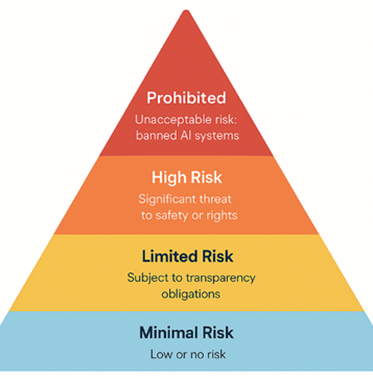
For automotive ADAS, the central question is whether a function — or an embedded component such as DMS — qualifies as high-risk, because that classification triggers design controls, documentation obligations, conformity assessment, and CE-marking-related duties.
EU AI Act Timeline: Key Compliance Dates for Automotive
|
Date
|
Milestone
|
|
1 August 2024
|
Regulation enters into force; institutional setup begins
|
|
2 February 2025
|
Prohibited AI practices become enforceable; organizations must ensure AI literacy for relevant staff
|
|
2 August 2025
|
Obligations for General-Purpose AI (GPAI) model providers apply — relevant if ADAS toolchains use third-party foundation models or GPAI-based in-vehicle assistants
|
|
2 August 2026
|
Core high-risk AI obligations apply: risk management, data governance, technical documentation, logging, transparency, human oversight, robustness/cybersecurity, quality management system, and post-market monitoring
|
|
By December 2027 (commonly referenced)
|
Additional transitional arrangements for certain AI-as-safety-component cases aligned with sectoral product legislation. Given long type-approval and SOP lead times, automotive programs should plan for earlier readiness.
|
Note: These timelines reflect publicly available guidance at the time of writing and are subject to change as further clarifications are issued.
When Does a DMS Become High-Risk Under the EU AI Act?
High-risk classification is governed primarily by Article 6, via two pathways:
- Article 6(1) — AI as a safety component of a regulated product (Annex I). If an AI system is itself a product, or a safety component of a product, covered by EU harmonisation legislation listed in Annex I, and that product requires third-party conformity assessment under that legislation, the AI system is high-risk. For automotive, this is relevant where an AI-enabled ADAS function sits within the safety case of the EU vehicle type-approval framework.
- Article 6(2) — AI systems listed in Annex III. Even outside Annex I product rules, an AI system can be high-risk if it falls under an Annex III use case — for example, biometrics or critical infrastructure/road traffic.
Practical Mapping for DMS (Driver-Facing Camera AI)
DMS typically uses in-cabin sensing (camera/IR, sometimes steering or physiological proxies) to infer driver state and readiness — attention, distraction, drowsiness, hands-off/on-wheel status, gaze direction, eyelid closure, and head pose.
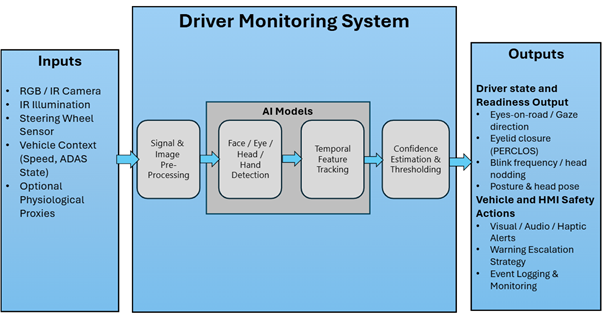
A DMS algorithm can become high-risk through several routes, depending on what it infers and how it's used in the vehicle's safety concept:
- As a safety component of the vehicle/ADAS feature set: If DMS gates or modifies safety-relevant functions — e.g., hands-off detection for L2/L2+ supervision, takeover readiness for L3, or escalation to Minimum Risk Manoeuvre logic — it strengthens the Article 6(1) high-risk argument.
- Biometrics / emotion recognition (Annex III): If DMS performs biometric identification (who is the driver), biometric categorisation (classifying a person by sensitive/protected attributes), or emotion recognition, it aligns with the Annex III biometrics category. Many modern DMS pipelines risk crossing into “emotion” territory if they claim to infer anger, stress, or frustration rather than safety-relevant fatigue/attention indicators.
- Profiling: Systems that build persistent driver profiles — e.g., a “risk score,” “fatigue propensity,” or behavioural baseline tied to an individual — carry higher regulatory exposure than ephemeral, trip-local state estimation.
- Road traffic safety context (Annex III critical infrastructure): While primarily aimed at infrastructure-level control, this category signals regulatory sensitivity toward any AI whose failure could cause road-safety harm — reinforcing a conservative classification approach for safety-critical in-vehicle monitoring.
'Intended Purpose' Drives Classification
Risk classification is strongly tied to a system's intended purpose and reasonably foreseeable use or misuse. For DMS, marketing claims and feature descriptions — “emotion detection,” “stress detection,” “driver identity,” “personalised risk scoring” — can shift the legal category even when the underlying model is similar.
Recommended approach: Define DMS as a safety-oriented driver state monitoring function (attention/drowsiness/distraction), avoid emotion-related labels unless strictly justified, and explicitly document boundaries — e.g., “not intended to infer health conditions, mental state, or protected attributes.” Because a provider's assessment that a system is not high-risk is subject to regulatory scrutiny, planning safety-relevant DMS as high-risk from the outset is the lowest-regret strategy.
High-Risk AI Requirements: What DMS Teams Must Build
High-risk classification effectively adds a parallel “AI safety case” that must be maintained across the lifecycle. For ADAS/DMS teams, this reshapes not just model performance work, but traceability, data discipline, monitoring, and evidence generation — you must be able to prove how the model was built, validated, controlled, and supervised in the field.
1. Risk Management System (Article 9)
Iterative lifecycle process: document hazards/harms, estimate and evaluate risks, define mitigations, and verify effectiveness across design, validation, deployment, and updates.
- Broader harm model: extend beyond functional safety to include risks to fundamental rights — e.g., discriminatory performance across demographics, intrusive monitoring, or misuse of in-cabin biometrics.
- Foreseeable misuse: account for repurposing of DMS outputs (e.g., insurance scoring, workforce monitoring) and define technical/contractual controls against it.
- Engineering integration: treat the AI Act risk file as an extension of the safety case (ISO 26262) and the SOTIF safety argument (ISO 21448), with explicit links to requirements, test evidence, and release gates.
2. Data and Data Governance (Article 10)
DMS performance depends on face/eye visibility across highly variable conditions — night/day, sunglasses, masks, skin tone, facial hair, headwear, seating position, occlusions, camera placement, and IR illumination. Article 10 requires that training/validation/testing datasets be relevant, representative, sufficiently complete, and as free of errors as possible, with bias actively monitored and mitigated.
Coverage matrix example:
|
Dimension
|
Example
|
|
Scenario
|
Night time indoor access control
|
|
Demographic
|
Skin tones V–VI, glasses
|
|
Hardware
|
Camera A (IR, 720p) vs. Camera B (RGB, 4K)
|
- Bias KPIs: report subgroup performance (e.g., false negative/positive rates for drowsiness/distraction events, gaze estimation error) with defined acceptance criteria and escalation rules when disparities exceed thresholds.
- Label governance: control labelling instructions, inter-annotator agreement, audit samples, and maintain traceability from labels to model versions.
- Domain shift controls: manage differences between development fleets and real vehicles (camera optics, IR wavelength, cabin materials) through calibration, adaptation strategies, and target-hardware validation.
- Synthetic/augmented data: document generation methods, realism limits, and impact on subgroup metrics.
- Special categories of data: DMS data can constitute biometric data and intersect with sensitive attributes. Apply strict necessity, access controls, and privacy-preserving measures, aligned with GDPR legal bases.
3. Technical Documentation and Traceability (Articles 11–12, 19)
High-risk AI systems require an Annex IV technical file plus record-keeping/logging for regulatory review. For DMS, this means an end-to-end configuration and evidence chain from data to deployed binary, covering:
- System description: intended purpose, operating design domain (ODD) assumptions, interfaces to ADAS decision logic/HMI, and limitations
- Model lineage: training procedure, hyperparameters, architecture, pre-processing, calibration, quantization, hardware dependencies
- Data lineage: dataset sources, consent/legal basis, retention, sampling strategy, annotation process, known gaps
- Performance and robustness: test protocols, subgroup metrics, stress tests (occlusions, sunglasses, extreme lighting), uncertainty handling
- Change control: versioning of datasets/models/code, “substantial modification” criteria, regression test gates
- Operational logging: what's logged (events, confidence, faults), retention periods, access control — avoid storing raw video unless strictly necessary; prefer derived event logs
4. Transparency and Information to Deployers (Article 13)
Providers must supply deployers — typically the OEM or fleet operator — with the information needed for correct use. Transparency also cascades into driver-facing documentation and HMI behaviour:
- Intended use and limits: what driver states are detected (and what aren't), expected operating conditions, known failure modes (e.g., sunglasses, extreme backlight)
- Output semantics: meaning of scores/flags/confidence, recommended thresholds, and how downstream ADAS logic should treat uncertainty
- Human-machine interface: how warnings/escalations trigger, timing constraints, minimum driver reaction assumptions
- Installation/calibration constraints: camera positioning, cleanliness, IR safety, servicing requirements
- Misuse prevention guidance: explicit restrictions on repurposing DMS signals for non-safety profiling unless separately assessed and legally grounded
5. Human Oversight (Article 14)
For real-time DMS/ADAS, human oversight isn't a manual review step — it means designing the feature so humans can understand, intervene, and recover when the AI is wrong or uncertain:
- Clear escalation ladder: multi-stage alerts with defined timing, including safe-state transitions when supervision can't be confirmed
- Fallback on uncertainty: degrade gracefully under low confidence (e.g., restrict hands-free mode) rather than forcing unsafe decisions
- Driver understanding: favor meaningful prompts (“Please look at the road”) over unexplained alerts
- Operational monitoring: OEM/fleet post-market monitoring to detect systematic false alerts or missed detections, with defined update pathways
6. Accuracy, Robustness, and Cybersecurity (Article 15)
- Measurable performance targets: specified accuracy/false-alarm limits under defined conditions, traceable to safety goals and driver acceptance (nuisance alerts drive feature disablement)
- Robustness testing: stress tests for occlusion, lighting extremes, eyewear, rapid head movements, camera degradation (dirt, scratches)
- Cybersecurity and spoofing: defend against presentation attacks (photos/videos), sensor blinding, and injection attacks on the DMS signal path; ensure secure boot, signed model artifacts, protected OTA updates
- Operational resilience: monitor drift and error patterns post-SOP; define triggers for corrective actions and software updates
Mapping the EU AI Act to Existing Automotive Standards
The good news: existing automotive safety, cybersecurity, and lifecycle standards provide a strong compliance foundation. Mapping standards such as ISO 26262, ISO 21448 (SOTIF), ISO/SAE 21434, ASPICE, and UNECE R155/R156 to the EU AI Act enables reuse of existing artifacts and reduces regulatory risk — while highlighting targeted gaps in data governance, explainability, and post-market AI monitoring.
|
Sr. No.
|
EU AI Act Requirement
|
Closely Aligned Automotive Standards
|
|
1
|
Risk Management System
|
ISO 26262, ISO 21448 (SOTIF), ASPICE
|
|
2
|
Data and data governance
|
ISO 21448, ISO/IEC 24029, ASPICE
|
|
3
|
Technical Documentation
|
ASPICE, ISO 26262, UNECE R156
|
|
4
|
Human Oversight
|
ISO 26262, SOTIF
|
|
5
|
Post-Market Monitoring
|
UNECE R155/R156, ASPICE
|
|
6
|
Accuracy, Robustness, Safety
|
ISO 26262, ISO 21448
|
|
7
|
Cybersecurity
|
ISO/SAE 21434, UNECE R155
|
Conformity Assessment, CE Marking, and AI-Specific Quality Management
High-risk AI systems must undergo a conformity assessment before being placed on the market or put into service (Article 43), leading to an EU declaration of conformity and CE-marking obligations. For automotive programs, the AI evidence package must be audit-ready and aligned with both AI Act requirements and existing vehicle compliance processes.
- Assessment route depends on category: For Annex III biometrics (point 1), conformity assessment may require a notified body depending on harmonised standards/common specifications used; other Annex III categories generally use internal control procedures. If the AI is embedded in a product regulated under Annex I product safety legislation, it's assessed via the relevant sectoral pathway.
- Quality Management System (QMS): Providers need an AI-capable QMS (Article 17) covering data governance, model development controls, verification/validation, release management, supplier management, and post-market monitoring.
- Substantial modifications: Material changes to the DMS model, thresholds, or operating conditions can trigger a new conformity assessment; any “continuous learning” capability must be tightly bounded and pre-documented.
ADAS Value-Chain Implications (OEM–Tier 1–Software Provider)
The AI Act assigns obligations by role, which may differ from traditional automotive supplier roles. A Tier 1 or algorithm vendor can be the “provider” if it places the DMS AI system on the market under its own name; the OEM becomes the provider if it integrates, brands, or substantially modifies the system under its trademark. This makes explicit contractual allocation essential for:
- Technical documentation ownership
- Dataset/legal basis responsibilities
- Post-market monitoring and incident reporting duties
- Update/change control approvals
Specific Impact on DMS Algorithms
Keep “Driver State” Distinct from “Emotion Recognition”
A key design/claims decision is whether DMS is framed as driver state monitoring for safety (attention/drowsiness/distraction) versus emotion recognition (anger, stress, happiness). Emotion recognition is explicitly called out under Annex III biometrics, and certain emotion-recognition use cases are prohibited outright (notably in workplaces and educational contexts). While in-vehicle DMS is a different context, adding “emotion” claims increases compliance burden and public sensitivity without a clear safety benefit. Many safety goals can be met using interpretable, physiologically grounded indicators — PERCLOS, gaze dispersion, head pose dynamics — rather than categorical emotions.
Biometric Identification, Categorisation, and Profiling: Minimize and Compartmentalize
- Avoid identity unless needed: If the safety function doesn't require identifying the driver, prefer anonymous state estimation. Where identification is needed (e.g., driver personalisation), implement it as a separate, well-scoped module with explicit user consent and clear retention rules.
- Prohibit sensitive inference: Do not infer protected attributes (race/ethnicity, religion, health conditions) from in-cabin video; enforce this in requirements, model design, and validation checks.
- Limit persistence: Prefer trip-local baselines and discard raw features; if long-term profiling (e.g., fatigue propensity) is used, document necessity, fairness, and opt-out mechanisms.
- Separation of concerns: Keep “safety DMS” outputs (attention/drowsiness confidence) separate from any commercial analytics to prevent function creep and reduce high-risk exposure.
Bias and Inclusivity as First-Class Verification Targets
For DMS, bias is a safety and usability issue, not just an ethical one. Systematically higher false negatives for certain demographics create unsafe supervision gaps; higher false positives drive alert fatigue and feature disablement. The AI Act pushes teams to quantify and manage these risks explicitly:
- Subgroup reporting: internal dashboards for key DMS KPIs across demographics and conditions (gaze estimation error distribution, drowsiness detection ROC/PR by subgroup, hands-off false-alarm rate by eyewear type)
- Calibration parity: ensure confidence scores are calibrated consistently across groups; define guard bands where confidence is unreliable
- Human factors validation: confirm HMI escalation behaves acceptably when DMS is wrong
- Edge-case governance: a structured pipeline for collecting/triaging difficult cases (sunglasses at night, extreme headwear, reflective spectacles) with explicit release criteria
Privacy-by-Design Operationalization (AI Act + GDPR)
The AI Act does not replace GDPR — both apply in parallel when personal data is processed. Treat privacy controls as part of the high-risk AI safety case:
- Maximize on-device processing
- Minimize or avoid storage of raw cabin video
- Log events and model health rather than biometric imagery
- Enforce strict retention/access policies
- Align AI Act risk management with GDPR DPIA processes for one coherent governance package
Implementation Checklist for ADAS/DMS Organizations
- Classification & claims: Define intended purpose; explicitly decide whether biometric identification or emotion recognition is present; document foreseeable misuse; record the high-risk rationale.
- AI QMS: Extend ASPICE/ISO 26262 processes with dataset governance, model/version control, bias monitoring, and “substantial modification” criteria for ML updates.
- Data governance: Establish coverage matrices and subgroup KPIs; document annotation SOPs; maintain traceability from raw data → labels → dataset versions → model versions.
- Verification/validation: Add fairness/robustness test suites, hardware-in-the-loop validation, and stress tests for occlusions/eyewear/illumination; define acceptance criteria tied to safety goals and user acceptance.
- Transparency package: Produce deployer instructions (limitations, thresholds, calibration requirements) consistent with driver HMI and manuals.
- Logging & post-market monitoring: Define privacy-preserving operational logs, fleet monitoring KPIs, incident escalation, and OTA update governance.
- Cybersecurity: Threat-model the camera/ML pipeline; protect model artifacts and update channels; monitor for spoofing and sensor attacks.
- Governance: Train staff for AI literacy; define internal audit readiness; ensure supplier contracts cover evidence sharing and monitoring responsibilities.
References
- Regulation (EU) 2024/1689 (EU AI Act) — key sections: Article 6 (high-risk classification), Articles 9–15 (high-risk requirements), Articles 16–26 (provider/deployer and supply-chain duties), Article 43 (conformity assessment), Articles 47–49 (declaration/CE marking/registration), Annex III (high-risk use cases), Annex IV (technical documentation)
- European Commission AI Act Service Desk (AI Act Explorer): Article 6, Article 16, Article 43, Annex III
- European Commission “Shaping Europe's Digital Future”fact page: General-purpose AI obligations under the AI Act (timeline and obligations for GPAI)
- Future of Privacy Forum / OneTrust (2025): “Conformity Assessments under the EU AI Act: A Step-by-Step Guide” (implementation-oriented reference)
Disclaimer: This article reflects publicly available regulatory guidance at the time of writing. Timelines and interpretations are subject to change; organizations should consult qualified legal counsel for compliance decisions.
Author
Specialist, Product line SYS & SW
Tata Elxsi