In 2027, the 5G network stops being something operators only sell by the gigabyte and becomes something enterprises can program. CAMARA is the open, shared rulebook that makes this possible: it lets every operator offer the same network capabilities to software developers in the same way. For operators, it is now the most practical route to 5G network API monetization.
The programmable network: 5G monetization’s next chapter
The next phase of 5G will be judged on what the network can do for a business, not just on how fast it is. Banks want to know if a customer's SIM card was just swapped. Broadcasters want guaranteed upload quality for a live match. Delivery firms want to confirm a device is where it claims to be.
Network APIs answer these needs. An API (application programming interface) is a standard way for one piece of software to ask another for information or an action. When an operator exposes a network API, an enterprise app can ask the network a question and get an answer in real time.
The old barrier was scale. No developer wants to write different code for every operator in every country. CAMARA and GSMA Open Gateway remove that barrier. As operators finalize their 2027 plans, the question is no longer whether network APIs matter, but how quickly each operator can turn them into recurring telecom operator revenue from enterprises.
What is CAMARA?
CAMARA is an open-source project hosted by the Linux Foundation that defines network APIs (often called telco APIs) once, so every participating operator implements them the same way. It was announced with the GSMA at Mobile World Congress in February 2022, with 22 founding partners including AT&T, Deutsche Telekom, Ericsson, Google Cloud, Microsoft, Nokia, Orange, Telefónica and Vodafone.
The promise is simple: build once, deploy everywhere. A developer who builds against a CAMARA API can, in principle, reach customers on any operator that supports it. By October 2025, the project counted more than 1,300 contributors from 476 organisations.
CAMARA publishes its work in tested bundles called meta-releases. The Fall25 release held 60 APIs. The next release, Sync26, was in its final stage in early November 2026 and moves Quality on Demand and Location Retrieval to more mature versions, right in time for 2027 planning.
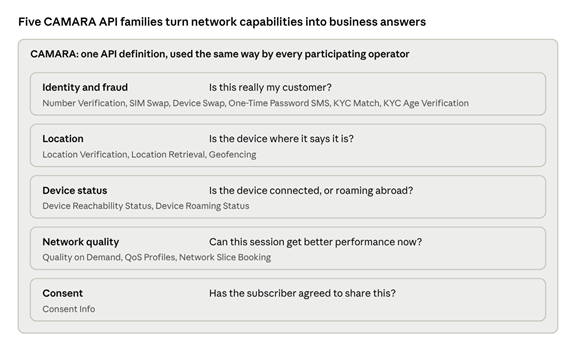
CAMARA API families · 5 groups, each answering one business question
Bottom line: Each family answers a question enterprises already ask. In 2027, the network itself can answer it, instantly and at scale.
CAMARA vs GSMA Open Gateway
The two names are often used together, but they do different jobs. CAMARA is the workshop where operators, vendors and cloud providers write the API definitions. GSMA Open Gateway, launched at MWC 2023, is the industry commitment to launch those APIs commercially, certify them and sell them through common channels.
A simple way to explain it: CAMARA sets the shape of the plug; Open Gateway gets every operator to install the socket and agree how to charge for the electricity.
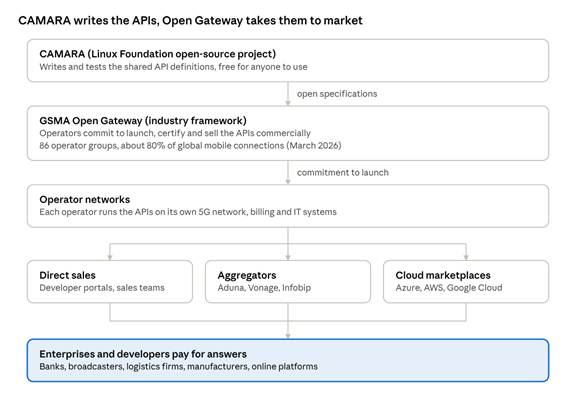
From specification to revenue · 5 stages, 3 routes to market
Bottom line: Operators control the middle of this chain. How well they connect standards to paying enterprises decides how much of the value they keep.
How operators turn network APIs into revenue: the 5G network API monetization model
Every time an enterprise app asks the network a question, the operator can charge for the answer. That simple mechanic sits at the heart of 5G network API monetization.
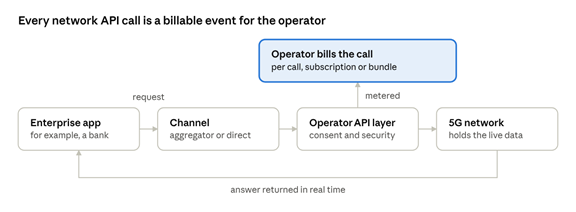
One network API call · request, consent check, answer, billing
The request travels through a channel to the operator's network exposure layer, which checks consent and security before the network answers. The operator meters the call and bills it.
Three 5G monetization strategies: routes to market
- Direct sales. Operators sell through their own developer portals and enterprise account teams. They keep the full margin but reach only their own subscribers.
- Aggregators and joint ventures. Aduna, a joint venture of Ericsson and 12 major operators including AT&T, Verizon, T-Mobile, Vodafone and Reliance Jio, bundles APIs from many operators into one platform. In July 2026 it launched a single Number Verification service across all three major US carriers.
- Cloud marketplaces. Microsoft offers Aduna's APIs through the Azure Marketplace, and Vonage sells network APIs through AWS Marketplace, putting operator capabilities where developers already work.
GSMA Intelligence sees the market moving toward platforms that give developers one integration point with global reach. For operators, that means planning for 2027 as a partner in a shared ecosystem, not a solo seller.
Enterprise use cases operators can productise in 2027
Fraud prevention is the proven starting point; live video, mobility and industry are the next wave. The table shows where each use case stands today.
| Use case |
APIs used |
What is already happening |
| Banking and payment fraud |
SIM Swap, Number Verification, Scam Signal |
UK operators and UK Finance built Scam Signal to help banks spot scam-linked transfers; national SIM Swap and Number Verification launches span Europe, Latin America, the Middle East and Asia |
| Digital identity and age checks |
KYC Match, Age Verification |
UK operators launched age verification and anti-fraud APIs in September 2025 for online platforms |
| Secure sign-in without SMS codes |
Number Verification |
Aduna went live across AT&T, T-Mobile and Verizon in July 2026 |
| Live broadcast and video |
Quality on Demand |
The BBC, France Télévisions and RAI publicly asked operators for standard Quality on Demand APIs in March 2026 |
| Payments, delivery and sport |
Quality on Demand |
Vodafone launched a Quality on Demand API in Germany in September 2026 |
| Remote driving and drones |
Quality on Demand, network APIs |
Elisa trialed Quality on Demand for remote vehicle driving; Telefónica and Nokia demonstrated drone operations |
| Manufacturing and enterprise apps |
Network quality and identity APIs |
Orange is working with Shabodi on manufacturing use cases |
Bottom line: Identity APIs are ready to scale now. Quality and slicing APIs are where operators can build higher-value enterprise products as 5G standalone networks expand.
What still stands in the way
The standards are largely in place; the hard part now is execution inside each operator.
| Challenge |
What it means for operators |
| Developer adoption |
Developers want broad coverage before they invest, and launches have been slower than analysts first expected. |
| Fragmentation |
A shared specification does not guarantee identical behaviour. Consent flows and service levels can still differ between operators. |
| Pricing |
Per-call, subscription and outcome-based models are all being tested, with no settled industry answer yet. |
| Revenue sharing |
Aggregators bring reach but take a share. STL Partners expects them to capture about 28% of identity and location API revenue by 2030. |
| Legacy systems |
Every call must be authenticated, metered, billed and supported. Many billing and operations systems were not built for real-time, per-transaction charging. |
| Security and privacy |
Identity and location data are sensitive, so consent, authentication and abuse protection must be built in from day one. |
| Network readiness |
Advanced quality APIs depend on 5G standalone, the newer 5G core that enables slicing. In January 2026, only 22% of operators with 5G had deployed it (STL Partners). |
Where implementation partners add value
Most operators have the network assets but not always the capacity to handle network API implementation and commercialization quickly. System integrators, telecommunications consulting firms and engineering partners close that gap across three stages.
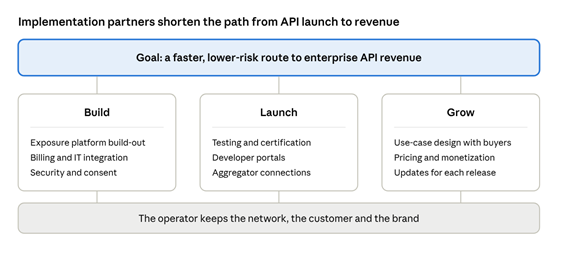
Where implementation partners add value · build, launch, grow
- Build Design the API exposure layer that safely connects outside developers to the network, link it to the 5G core and to billing and operations systems for real-time charging, and build in consent and security.
- Launch: Prepare implementations for GSMA Open Gateway certification, stand up developer portals and test environments, and connect to aggregators and cloud marketplaces.
- Grow: Shape solutions with banks, broadcasters, logistics firms and manufacturers, model pricing and revenue-share terms, and lead ongoing API enablement, keeping every API current with each new CAMARA release.
Bottom line: The real value is reuse. Once the foundation is built, each new API launches faster and cheaper than the last.
The road from 2027 to 2030
2027 is the year identity APIs move from launch to scale, and quality APIs move from pilots to products. The roadmap below is a suggested path for operators, built on what the market already shows.
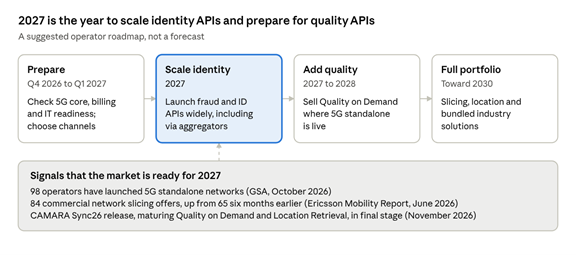
Suggested operator roadmap · 4 phases, Q4 2026 toward 2030 (not to scale)
Three forces make the timing right. 5G standalone networks are reaching critical mass, network slicing is already being sold commercially, and the core CAMARA APIs are maturing. Meanwhile, competitors are going live: with all three major US carriers on Aduna and multi-operator launches across Europe, Latin America and Asia, operators without APIs risk being left out of enterprise and developer workflows.
The operators who use the next two months to finalize their API plans will enter 2027 shaping prices and partnerships. Those who wait will accept terms set by others.
Key takeaways
- CAMARA builds the APIs, GSMA Open Gateway takes them to market. Open Gateway is now backed by 86 operator groups covering about 80% of global mobile connections.
- Identity and fraud APIs earn money today. Quality on Demand and network slicing are the next wave, as 5G standalone networks spread.
- 2030 forecasts range from about $8 billion to $31 billion in direct network API revenue.
- The race in 2027 is about execution: connecting APIs to existing systems, aggregators and enterprise buyers faster than competitors.
Conclusion: build the programmable network now
CAMARA has solved the standards problem, and GSMA Open Gateway has aligned the industry. What remains is execution: connecting APIs to existing systems, getting consent and security right, choosing the right channels and building enterprise solutions customers will pay for.
For operator leaders, 5G network API monetization in 2027 is no longer a question of whether, but how fast and how profitably. Start with identity and fraud APIs, where demand is proven. Build the exposure and billing foundation once. Then extend to Quality on Demand and network slicing as 5G standalone coverage grows. Operators that move now, with the right implementation partners, will define the programmable network era rather than follow it.