
Case Study
Accelerating Software Validation Through Virtualization and Automated Testing
Enabling faster software development through virtual testing

>95%
Reduction in Testing Time
10 Days → <8Hrs
Validation Time
100%
Software Compatibility
Background
As vehicle software continues to grow in complexity, automotive organizations are under increasing pressure to accelerate validation cycles while maintaining software quality. Traditional testing approaches often depend on physical hardware availability, creating bottlenecks that slow development and delay feedback.
To support faster software releases and improve validation efficiency, the customer sought a scalable approach that would enable early software testing, reduce dependence on physical test benches, and integrate seamlessly with modern development workflows.
Challenge
The customer's software validation process was heavily dependent on physical ECU hardware and test bench availability, resulting in lengthy testing cycles and delayed feedback during development. Validation activities could only begin once the hardware was available, limiting opportunities for early defect detection and increasing overall program timelines. In addition, executing and repeating tests required significant manual effort, making regression testing difficult to scale as software complexity increased. The customer needed a solution that could enable earlier testing, reduce validation bottlenecks, improve testing efficiency, and support faster software releases without compromising quality and reliability.
Solution
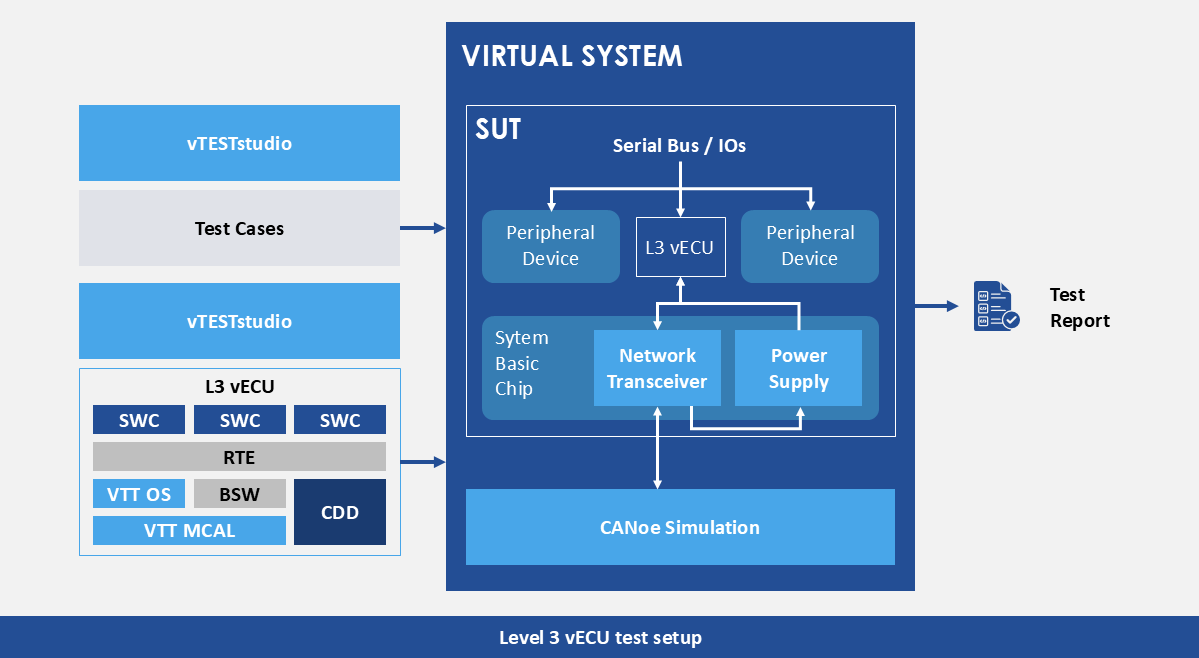
Tata Elxsi implemented a virtual ECU (vECU) environment leveraging the Vector virtualization and automated testing ecosystem to enable Software-in-the-Loop (SIL) validation independent of physical hardware availability. The solution virtualized key ECU software components while maintaining functional equivalence with the production environment, allowing the same application software and AUTOSAR stack to be validated in a virtual setup. Network communication, peripherals, and operational scenarios were simulated to accurately replicate real-world ECU behavior. Tata Elxsi also automated qualification and regression testing workflows, significantly reducing manual effort and improving repeatability. The virtual validation environment was integrated into continuous integration and testing pipelines, enabling scalable, automated, and hardware-independent software verification across the development lifecycle.
Impact
- Reduced software testing time from 10 days to less than 8 hours.
- Accelerated validation cycles through automated Software-in-the-Loop (SIL) testing.
- Enabled software verification before physical hardware availability, supporting shift-left development practices.
- Reduced manual testing effort through automated regression and qualification testing.
- Improved defect detection and debugging through earlier and more frequent validation cycles.
- Increased testing scalability through integration with continuous integration and continuous testing workflows.
Services Rendered
- ECU Virtualization
- Software-in-the-Loop (SIL) Testing
- Embedded Software Validation
- Test Automation
- Continuous Integration & Testing