
Case Study
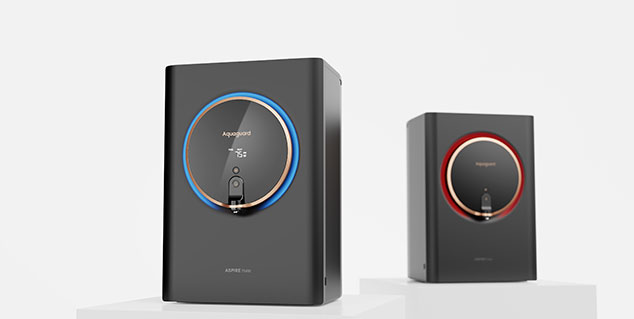
Aquaguard Aspire Halo - Turning a utility appliance into a design-led lifestyle product
Design-Led | Built to Scale | Intelligence Made Visible
20%
Faster water flow
12
Stages of Purification
2 Years
Filter life
Background
India's water purifier market stood at USD 3.6 billion in 2025 and is growing at 8.4% a year, with households accounting for 44% of demand. Yet a growing market has not produced better products. Competition is still fought on filtration stages and feature counts, leaving a category that is technically capable but visually cluttered and cognitively demanding. As appliances move from first purchase to upgrade, the purifier is no longer judged only on what it removes but on how it looks and feels in an open modern kitchen.
Eureka Forbes approached Tata Elxsi to design Aquaguard Aspire Halo: a smart purifier reflecting current market trends while adhering to the brand's established minimal design language. The ambition was to make advanced purification feel effortless, and to make intelligence visible without adding noise.
Challenges
Designing a smart water purifier in today's competitive market presents challenges that span user expectations, technological integration and design differentiation.
- Balancing Capability with Simplicity: Twelve stages of purification had to sit behind a minimal, intuitive interface that require engineering, UX and brand aesthetics to be resolved together, not sequentially.
- Differentiating in a Cluttered Category: The category is dominated by feature-heavy products with visually busy interfaces, making meaningful design differentiation difficult to achieve.
- Manufacturing Feasibility: The design had to remain producible at scale by balancing aesthetics against cost, material selection and assembly simplicity.
- Diverse Conditions & User Awareness: Input water varies widely across Indian homes, as does user understanding of what purification actually does. The design had to reassure both the informed and the uninformed.
Solutions
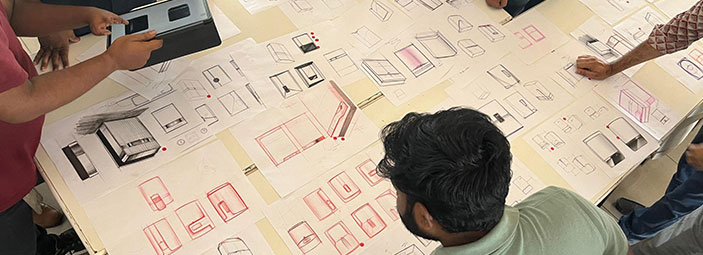
One integrated design process with form, interaction and intelligence resolved together rather than handed between teams.
- Research & Trend Alignment: Consumer and category research established where the brand's minimal design language could stretch, and what a design-first purifier had to look like in a modern kitchen.
- Form, CMF & Interaction as One: Industrial design and interface design were developed in parallel. The halo ring is not only an indicator added to a form — it is the form, carrying alert, purification and standby states.
- Intelligence Made Legible: Live TDS and system status were designed as a visual language first, then specified into the electronics thus keeping the smart layer readable rather than buried in menus.
- Design for Manufacture & Compliance: Standards alignment, material selection and assembly simplicity were carried through the design phase itself, keeping the aesthetic producible at category price points.
Impact
A premium smart water purifier that enhances user confidence, complements modern lifestyles and sets a new benchmark in the category.
- Strong Differentiation: Elevates perception from utility product to lifestyle appliance, standing out in a category dominated by feature-heavy but visually cluttered products.
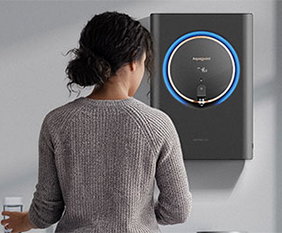
- Premium Design & Emotional Connection: A design-first, minimal aesthetic aligned with modern kitchen trends, appealing directly to urban, design-conscious consumers.
- Improved Trust & Transparency: Live TDS and a single status ring build confidence in water quality, reducing uncertainty around safety without demanding attention.
- A New Category Benchmark: Demonstrates that intelligence, intuitive interaction and visual restraint can coexist in a mass-market appliance.
Services Rendered
- Consumer & Trend Research
- Industrial Design
- Product Form & CMF Design
- User Interface & Interaction Design
- Design for Manufacturability
- Standards & Compliance Alignment
- Material & Cost Optimisation
- Design Validation