

News
Cobots and XR Interfaces: Redefining Safety and Intelligence in Indian Smart factories
Date: Jul 14 2026
Publication: Emerging Manufacturing
The next phase of industrial automation is not about replacing people but empowering them. By combining cobots with immersive XR technologies, manufacturers can improve productivity, strengthen safety, and create a more skilled and confident workforce.
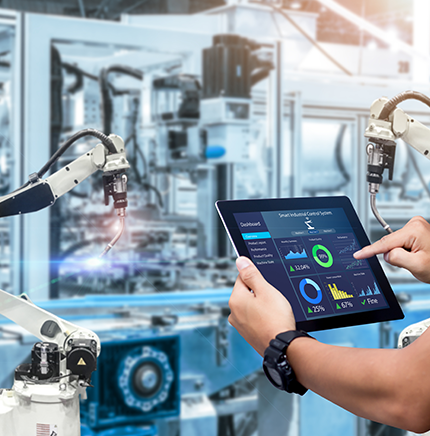
Indian manufacturing is moving beyond basic automation toward systems that are faster, safer, and genuinely easier for people to work with. Collaborative Robots (Cobots) paired with Extended Reality (XR) interfaces are emerging as one of the most practical ways to achieve this on Indian shopfloors. The combination allows workers to train in immersive environments, reduces the chance of accidents, and makes advanced automation feel less intimidating, especially for plants that cannot afford large-scale overhauls.
Immersive Training That Builds Real Skills and Muscle Memory
XR is transforming how industrial training happens. Instead of relying only on manuals or classroom sessions, workers can now learn complex or dangerous procedures in virtual or augmented environments before they come in contact with real equipment. Augmented Reality (AR), Virtual Reality (VR) and Mixed Reality (MR) overlays show exactly how to approach a cobot cell, react to system prompts, and perform maintenance steps in the correct sequence.

Digital twins go a step further. A virtual copy of the robot cell lets operators test operating procedures, simulate faults, and practise setup or changeovers without any physical risk. What makes these simulations especially effective is haptic feedback. Workers receive realistic tactile sensations of touch, pressure and resistance that help build muscle memory for repetitive tasks. This bridges the gap between virtual practice and live execution, particularly where feel and precision matter as much as visual steps.
Safety Built In, Not Bolted On
Cobots are designed to work alongside people, but safe operation still requires careful planning and adherence to standards. Frameworks such as ISO 10218 and ISO/TS 15066 set clear requirements for how collaborative robot applications should be designed, configured and operated. XR adds to this layer of safety by enabling workers to rehearse safe behaviours from day one.
Rather than learning through on-the-job trial and error, operators can practise safe entry methods, part loading, virtual emergency stops and maintenance access in a controlled virtual environment. This is particularly beneficial where human and machine interaction is common. When workers understand movement zones, operating logic and stop conditions before they encounter them in reality, the risk of accidental contact or procedural mistakes is greatly reduced. XR training also helps reinforce safe habits by addressing certain cognitive behaviours through repeated low-risk exposure.
Higher Output, Lower Risk in Labour-Intensive Sectors
The cobot-plus-XR approach brings clear benefits in labour-intensive sectors such as automotive components, fabrication and general engineering. These environments often involve repetitive movement, manual handling and tasks that become physically demanding or risky over long shifts. Cobots can reliably handle pick-and-place, part feeding, screwdriving, machine tending, light assembly and inspection support, freeing human operators for supervision, troubleshooting and work that requires judgment or dexterity.
XR adds another layer by standardising how tasks are learned and performed. When the same guidance framework is used across teams and plants, training becomes more consistent and avoidable errors decrease. In practice, properly trained systems have shown efficiency levels above 90%. One skilled operator, supported by cobots and XR-guided processes, can now oversee output volumes that previously required far more manual effort, turning repetitive execution into high-volume, supervised operations with minimal error.
Modular Automation That MSMEs Can Actually Scale
For most Indian MSMEs, large automation projects are often too expensive and complex to implement in one go. A modular approach makes far more sense. It starts with one cobot, one process and one training workflow, then expands once the results are clear. This model aligns closely with SAMARTH Udyog Bharat 4.0, which helps manufacturers, particularly MSMEs, understand and adopt Industry 4.0 technologies through demonstration and development centres. The focus is on building real capability rather than expecting every plant to leap into full-scale smart manufacturing immediately.
Practical MSME-ready systems need low footprint, simpler deployment and manageable upfront costs. A modular approach works well because it lets plants add capability over time instead of committing large capital upfront. Hardware accessibility is also improving quickly. Many XR solutions today run on regular mobile phones and tablets, making them device-agnostic and far less expensive than dedicated VR headsets. Industrial-grade devices suitable for shopfloor use are already available in the ₹30,000-₹50,000 range, with more compact options coming for specific tasks. As competition and adoption grow, costs should come down further, supporting the modular scaling that Indian MSMEs need.
Local Languages, Global Technology
Language remains a critical factor on Indian shopfloors. Many workers are more comfortable with regional languages than technical English, so effective systems must provide voice prompts, captions and instructions in Hindi, Kannada, Tamil, Telugu and other local languages. Modern XR and AI tools already support real-time translation, text overlays and voice guidance, making interfaces usable for a much wider workforce.
This capability is more than a convenience. It is a safety feature. When workers clearly understand every step, they are far less likely to miss warnings or make incorrect moves during setup or maintenance. The technology is already practical rather than aspirational. Industry terms are consistent across languages, and real-time translation is well integrated with XR and core AI engines, turning language diversity from a potential barrier into a manageable advantage.
Human Oversight, Supercharged by Technology
Even as robots become more capable, human oversight remains essential. Quality validation, exception handling and process review still need people, particularly in mixed-production environments where part variation and frequent changes are common. The real shift is that one skilled operator can now manage far more repeatable work with the support of cobots and XR guidance. Instead of doing every action manually, that person can supervise multiple lines. review output and step in only when judgment is needed.
This is about augmentation rather than replacement. It improves how people work while still requiring human oversight. As generative Al continues to evolve, cobots will increasingly be able to learn from their own actions over time, reducing errors further and allowing humans to focus on higher-value oversight and problem-solving.
Momentum Is Building: What Indian Factories Can Expect Next
The next wave of adoption will come from plants seeking measurable gains in safety, training speed and process consistency without massive infrastructure changes. Cobot-plus-XR systems are particularly well-suited for changeovers, maintenance training and repetitive assembly work. As device costs continue to fall and software becomes easier to deploy, these solutions will reach smaller plants more easily.
Adoption momentum is already visible. Large organisations in automotive, manufacturing, power and energy sectors have begun integrating these technologies, and MSMEs are starting to follow. While infrastructure costs and workforce resistance to change remain real considerations, the direction is clear. Wider shopfloor acceptance is approaching faster than many anticipate.
The long-term opportunity is a manufacturing environment where workers learn faster, robots operate more safely, and output becomes more stable across shifts and sites. For Indian manufacturing, this represents a shift toward smart factory adoption that feels less like a disruptive leap and more like a series of practical, human-centred steps.
Author: Maulik Raval, Practice Head, VXR, Tata Elxsi