

News
Smart Rail Infrastructure: Leveraging Digital Twins for Predictive Maintenance and Operational Excellence
Date: Dec 15 2025
Publication: Themachinemaker
Today, the rail network is undergoing rapid changes; it is transforming from a purely electromechanical system to an evolving digital ecosystem. Global demands on rail transport for both passenger and freight operations continue to rise, which makes modernisation inevitable. For rail operators & rail infra managers everywhere, it boils down to understanding how to provide more efficient, reliable & punctual services without ever compromising safety. The solution is tied to making every physical piece of the rail network system an intelligent, data-generating asset. In such a far-reaching transition, smart sensors, edge computing, and digital twins are in the driving seat, transforming Rail infrastructure that will actively monitor, predict faults, provide a complete picture of the system in operation, and keep the future of mobility secure.
The Foundation of Intelligence: Sensorization and Predictive Maintenance
To build any smart rail system, whether it be real-time tracking, predictive maintenance, or advanced digital twins, the first essential step is sensorization of the various elements of the system. It means providing every critical part with the ability to talk and report upon its own health and status directly.
The current approach emphasises placing connected sensors on the highest-risk equipment, which are the assets whose failure would result in significant delays to service or compromise safety. The main driver of this method is RCM, or remote condition monitoring. Continuously collecting data related to various parameters, for example, heat, vibration, current, acoustics and many others, gives operators & rail infra managers instant insight into the health of the equipment. This completely reverses the script on maintenance, where instead of reacting to the failures, operators and rail infra managers now have a continuous understanding of the condition of the part/equipment and therefore proactively schedule a maintenance or replacement. This proactive, intelligent intervention not only saves money but also maximises equipment life and maintains reliable train service with the least disruption possible.

Computational dilemma: Balancing the Edge and the Cloud
With the increasing amount of data (from RGB cameras, Ultrasonic Sensors, Lidars, etc.) being generated from the sensorized rail network, it requires a smarter approach in processing the large volumes of data. The processing of the data can be done either on the Edge device itself or on the cloud/on-premises server. The choice depends on some key factors. One key factor is the latency requirement. For example, the data captured of the rail wheel in the form of images or Lidar scans or ultrasonic sensors is used to identify various defects such as cracks or damage. Real-time analysis in this case is critical for ensuring defects are discovered, and alerts are relayed quickly to prevent any further damage to the equipment and prevent accidents, and thus, edge computing is preferred. However, for doing trend analysis of a condition of a part or doing predictive maintenance, using cloud computing/on-premises server would be a preference, as it is not required to be real-time. Additionally, connectivity & bandwidth are key factors in deciding edge versus cloud. Rail networks, especially the mainline ones, have limited or intermittent connectivity & bandwidth in remote areas, and thus edge computing comes in handy to process the data. The cost of data transmission is also a key factor in this decision, depending on whether a wireless network is used for transfer. With increasing coverage of 5G networks, especially in the urban rail network, the choice between edges versus cloud would require a relook based on economics.
The magic is all about achieving that perfect balance: the edge takes care of fast, expensive, and critical action, while the cloud maintains a complete, secure history of it all for audits and long-term analysis. As computing on the edge shrinks in size and gets cheaper with increasing computational power, the accuracy and performance of such systems will only continue to get better, enabling safer, efficient, and reliable train operations.
The Ultimate Goal: Seamless Operations and the Digital Twin
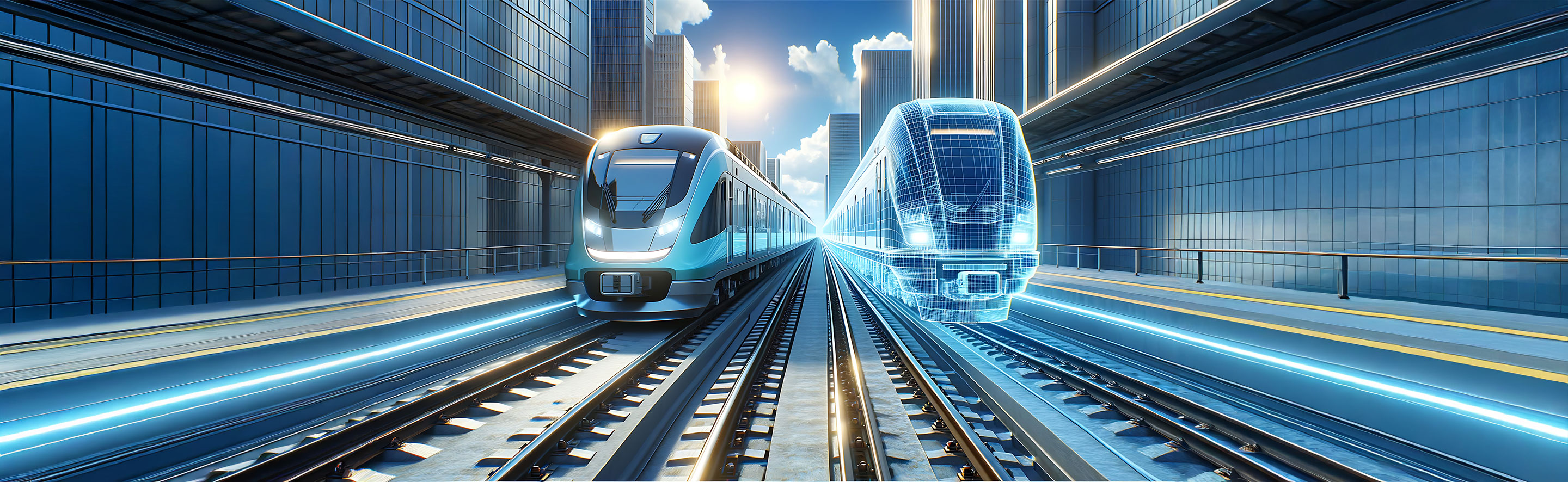
All that sensor data and smart edge processing come together to create the Digital Twin. Digital Twins are a high-fidelity virtual copy of either an actual rail infrastructure, from every piece of track and station or a complex signalling system, or an onboard system and even the rail network. Due to the constant feeding of real-time data from sensors on the network, it is always up-to-date.
Rail operators and rail infra managers can leverage Digital Twin to achieve various positive outcomes both in day-to-day operations as well as for a long-term view. For example, a digital twin of a railway station can be used to understand the impact on customer convenience and train operations due to proposed modifications/upgrades or due to maintenance activities as part of infrastructure updates and planning. Proactive planning can be done to handle increased metro train usage due to holiday seasons or due to major events happening in the city. In the freight rail operations, the Digital Twin of a yard can enable operators to plan for what-if scenarios, improve the velocity of the network, and reduce the dwell time of rail cars. Digital twin of an onboard system or off-board system, or part can help operators predict the failure when subjected to unique situations which otherwise are difficult to recreate in normal operations. Additionally, Digital Twin can help simulate emergency scenarios or breakdowns to understand the wider impact it can have in the network and help train emergency/operations/maintenance crews to prepare in a safe way.
The Digital Rail Ahead
The future of rail is more than just building faster trains; it is about building smarter infrastructure. By establishing a strong digital pulse using everything from detailed sensor data to strategic edge analytics, the industry is finally leaving behind the costly era of fixing things only after they break. This huge shift toward intelligent, software-defined monitoring and Digital Twins is the core mandate for modern rail operators & rail infra managers. It guarantees that we can stay operationally nimble & efficient, get the most life out of our assets, and ultimately deliver the continuous safety and availability that people & customers everywhere expect from the Rail industry.
Author: Sandeep MV, Head of Rail Industry, Tata Elxsi