

CXOToday Interview on PFAS Regulations
Explore how evolving PFAS regulations are driving innovation in the medical device industry, prompting a shift towards safer material alternatives without compromising device quality.
Read ArticleGlobal Trade Compliance Services
Global supply chains are becoming increasingly complex, making Custom & Trade Compliance essential for seamless cross-border movement of products, regulatory compliance, and uninterrupted market access. Evolving customs regulations, Country of Origin (COO) requirements, tariff classification, Free Trade Agreements (FTAs), sanctions, and product labeling requirements demand consistent governance across enterprise systems, supplier documentation, manufacturing operations, and customs records.
Organizations often struggle with fragmented data across ERP, PLM, MES, supplier, and logistics systems, resulting in customs delays, incorrect tariff applications, market access restrictions, and costly remediation efforts. Tata Elxsi's Global Trade Compliance Services establish a centralized governance framework to determine, validate, and maintain compliant trade information across product labels, regulatory records, supplier documentation, and enterprise systems. By creating a single source of truth for trade compliance data, we help organizations reduce compliance gaps, strengthen traceability, mitigate customs and supply chain risks, and build scalable governance for sustained global compliance.


Here's How We Help?
Building a Strong Compliance Foundation
- Assess custom and trade compliance maturity, identify process gaps and embed standardized workflows directly into QMS with cross-functional awareness
- Evaluate the business impact of compliance gap, run risk analysis, and define the scope of remediation needed before work begins
Enterprise Data Reconciliation & Supplier Collaboration
- Reconcile trade compliance data across ERP, SAP, PLM, MES, supplier portals, logistics systems, customs records, and regulatory databases to establish a single source of truth.
- Engage suppliers to collect and validate COO declarations, product classification data and resolve documentation gaps.
Accurate Classification, Origin Determination & Validation
- Determine and validate Country of Origin based on substantial transformation principles, applicable trade rules, and market-specific requirements.
- Review and maintain HS/HTS tariff classification and export classification codes across the product portfolio.
- Identify discrepancies across enterprise systems and assess the impact on regulatory (label, IFUs etc.) and customs documentation
Remediation & Continuous Compliance
- Execute remediation programs, manage labeling and documentation updates and prepare audit ready compliance evidence packages.
- Establish governance, continuous monitoring and AI-enabled automation to sustain long-term compliance and market access.
Trade Compliance Intelligence
- Continuously monitor global trade and customs regulations, tariffs, FTAs, and geopolitical risk.
- Deliver AI-driven compliance insights, predictive risk alerts, and market access intelligence to enable proactive trade compliance.
Our Global Trade Compliance Framework
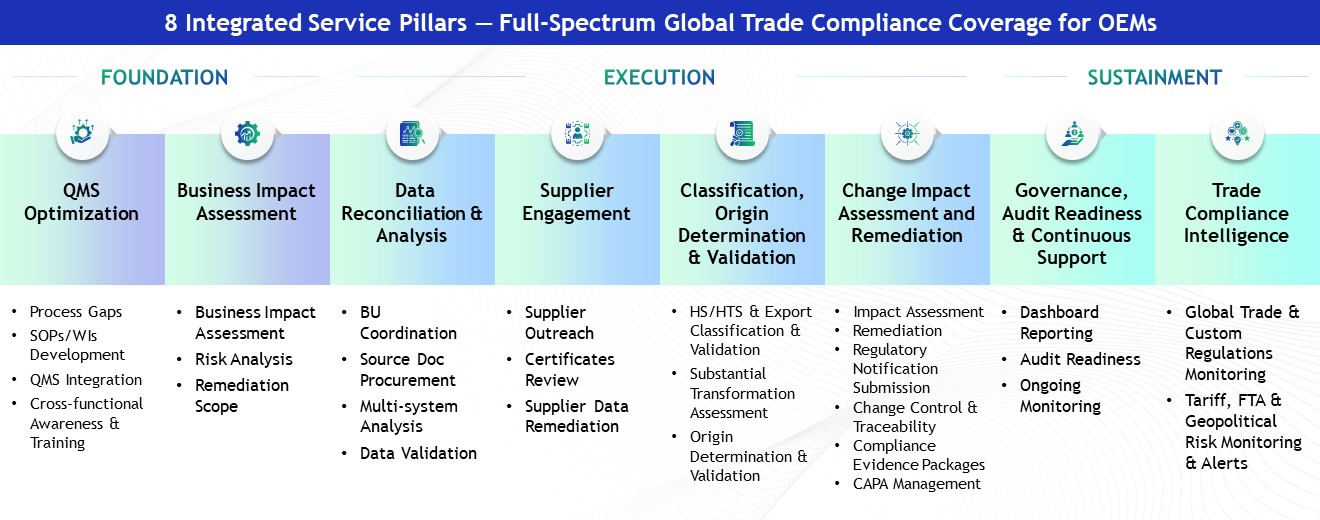
Tata Elxsi's Global Trade Compliance Framework provides a structured approach to accurately determine, validate, and maintain compliance across global product portfolios. Combining engineering and regulatory expertise, enterprise-wide data reconciliation, supplier collaboration, and AI-enabled intelligence, the framework helps organizations establish a single source of truth, accelerate remediation programs, strengthen governance, and maintain audit-ready compliance across evolving global trade and regulatory landscapes.
Assess & Align
Establish the foundation for trade compliance by evaluating customs and trade compliance maturity, integrating workflows into the QMS while assessing the business impact and risk remediation is scoped accurately before execution begins. Enterprise data is collected from ERP, SAP, PLM, labeling systems, and supplier records to identify remediae documentation gaps.
Determine & Validate
Tata Elxsi's AI-enabled Country of Origin determination methodology accelerates large-scale compliance programs through a structured five-step approach that analyzes intended product purpose, identifies major components, evaluates substantial transformation, determines the region of transformation, and generates analyst-reviewed Country of Origin determinations supported by confidence scoring, CBP references, and complete audit trails.
Remediate & Govern
Assess the impact and execute remediation including regulatory documentation (label, IFU etc), regulatory notification submission where required, customs & trade documentation updates and CAPA management while supporting the audit readiness. Standardize governance frameworks, continuous monitoring, and trade intelligence help sustain long-term compliance and support seamless global market access.
Why Tata Elxsi?
- Proven experience delivering high-volume COO at customs and trade compliance programs across global product portfolios.
- AI-enabled 5-step COO determination methodology delivering up to 6× faster execution, 59% lower remediation effort, and 100% audit-ready evidence packages.
- End-to-end capabilities spanning Substantial Transformation Assessment, Regulatory Compliance, Customs Compliance, Trade Compliance, Enterprise Data Reconciliation, Supplier Engagement, Remediation and Governance.
- Expertise across SAP, ERP, PLM, MES, labeling, and supplier ecosystems to establish a trusted source of trade compliance data.
- Accelerated audit readiness through evidence packages, explainable compliance decisions, and continuous regulatory and trade intelligence.



Information Hub
-
Why is Country of Origin compliance critical for medical device OEMs?
Country of Origin is no longer simply a label on a box, it is a foundational compliance requirement that impacts customs duty rate, and eligibility for market access across every country it enters. Regulatory and Custom authorities worldwide require accurate, documented COO as part of product labelling and import clearance. A single COO discrepancy across systems or documentation leads to import delays, compliance issues, penalties, and increased costs.
-
What are the key trade compliance challenges for medical device manufacturers?
Increasing tariffs, evolving regulations, and complex global supply chains are making compliance more challenging than ever. Incorrect trade data or documentation can lead to customs delays, financial losses, and regulatory actions.
-
How does Global Trade Compliance improve supply chain performance?
Accurate trade compliance enables faster customs clearance and uninterrupted product movement across borders. It improves supply chain reliability while reducing operational and compliance risks.
-
Why is data reconciliation important for Global Trade Compliance?
Consistent product and trade data across ERP, PLM, MES, and labeling systems is essential for compliant trade decisions. Data reconciliation eliminates inconsistencies and creates a reliable source of truth.
-
What business benefits does a centralized Global Trade Compliance program provide?
A centralized program standardizes compliance processes, improves governance, and enhances audit readiness. It also reduces operational costs while ensuring consistent compliance across global operations.
-
Can Global Trade Compliance be outsourced?
Yes, specialized service providers can manage trade compliance activities such as Country of Origin, HS classification, customs documentation, and regulatory compliance. This reduces compliance risk and allows OEMs to focus on innovation and business growth.