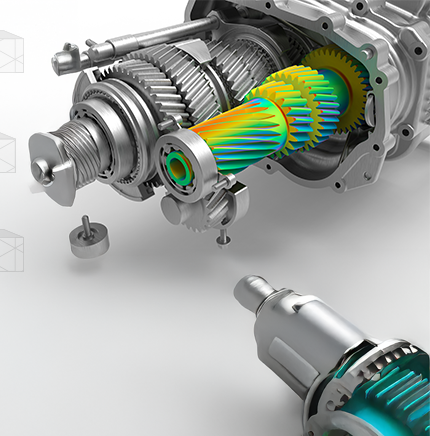
As electrification accelerates, Noise, Vibration, and Harshness (NVH) has emerged as a defining factor in electric drive unit (EDU) performance and customer perception. Gear whine—driven by microgeometry, operating loads, and manufacturing variation-remains one of the most challenging NVH issues in modern EVs.
Traditional NVH development relies on CAE iteration loops and extensive dyno testing. While effective, these approaches are:
Time-intensive
Prototype-heavy
Prone to late-stage surprises
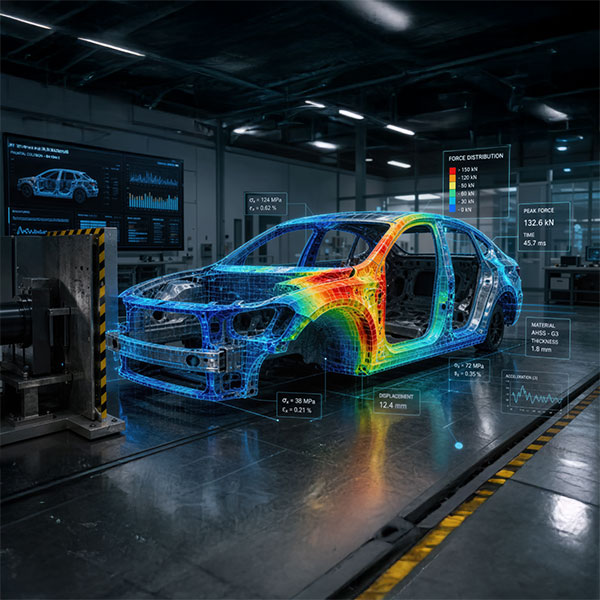
To address this, we introduce a data-driven virtual validation framework, powered by AI-based surrogate models. This approach transforms NVH engineering from reactive troubleshooting into a predictive, target-driven design process.
Driving Efficiency Through AI-Powered Virtual Validation
At the core of this framework lies an AI surrogate model trained on CAE simulations or historical test data. This model acts as a fast, predictive engine capable of evaluating NVH performance in milliseconds.
The workflow integrates:
Design of Experiments (DOE) to generate representative datasets
Neural network-based surrogate modeling for rapid predictions
Explainability techniques (SHAP) to identify key NVH drivers
Inverse optimization to derive optimal microgeometry from target NVH
Monte Carlo simulations to account for manufacturing variability
This enables engineers to simulate thousands of design possibilities instantly, eliminating the need for repeated physical validation loops.
Insights That Shape Design Decisions
A key advantage of this approach is its ability to provide deep engineering insights early in development.
Quantifies the effect of manufacturing tolerances on acoustic performance
Incorporates psychoacoustic weighting, aligning optimization with what customers actually perceive as annoying
Instead of guessing and validating, engineers can now directly understand cause–effect relationships and prioritize the most impactful design changes.
From Forward Simulation to Inverse Design
Traditional engineering follows a forward approach:
The AI-driven framework enables a paradigm shift to inverse design:
By inputting:
Acoustic limits
Order-cut curves
Customer annoyance thresholds
…the system outputs a microgeometry blueprint that meets performance targets.
This dramatically reduces trial-and-error, allowing for target-first engineering.
Enabling Robust and Scalable Manufacturing
Beyond design optimization, the framework ensures manufacturing readiness:
Virtual builds simulate large production populations using Monte Carlo methods
Predicts yield, pass/fail rates, and process capability (Cpk)
Identifies non-critical tolerances that can be relaxed to reduce cost
Finds robust design zones resilient to process variation
This ensures that NVH performance is not just achieved in prototypes—but consistently delivered in production.
Transforming Validation Through Intelligent Experimentation
Validation is redefined using active DOE and uncertainty-driven sampling:
Recommends only the most informative prototypes
Eliminates redundant testing
Reduces validation time and cost significantly
The result is a shift from:
Broad, expensive prototype campaigns to Lean, targeted validation strategies.
Strategic Impact: Speed, Cost, and Confidence
The data-driven virtual validation approach delivers measurable advantages:
Faster time-to-market Replace weeks of simulation cycles with millisecond-level iteration
Reduced validation cost Minimize prototype builds through targeted testing
Improved decision-making Gain explainable insights into NVH drivers
Lower production risk Validate robustness and tolerance sensitivity early
Optimized cost-performance trade-offs Balance machining complexity with acoustic performance
Looking Ahead: AI-First NVH Engineering
The future of NVH engineering lies in AI-native, data-driven development environments, where:
Surrogate models evolve into real-time digital twins
Optimization becomes continuous across lifecycle stages
AI integrates with CAE to create closed-loop intelligent systems
This convergence will enable:
Predictive NVH diagnostics
Autonomous design optimization
Scalable platform engineering
Conclusion
Tata Elxsi’s data-driven virtual validation framework represents a fundamental shift in EDU NVH engineering. By combining AI, simulation, and manufacturing intelligence, it enables:
Faster design convergence
Reduced development cost
Robust, production-ready solutions
More than a tool, it is a strategic enabler for next-generation electric mobility-ensuring vehicles are not only efficient, but also acoustically refined and customer-centric.
When you visit a website, it may store or retrieve information in the form of cookies on your browser. This information may pertain to you, your preferences, or your device and is mainly used to ensure that the site functions as expected.