The Packaging and Packaging Waste Regulation (PPWR) is the European Union's new packaging law that sets harmonized requirements for packaging design, recyclability, reuse, recycled content, labelling, and waste reduction. It applies to all packaging placed on the EU market and will impact manufacturers worldwide that export products to Europe. The regulation entered into force in February 2025 and generally applies from 12 August 2026.
What is PPWR?
The Packaging and Packaging Waste Regulation (PPWR) (EU 2025/40) is the EU's flagship legislation for reducing packaging waste and accelerating the transition to a circular economy. It replaces the previous Packaging and Packaging Waste Directive and introduces a common set of rules across all EU Member States.
Unlike a directive, which requires national implementation, a regulation applies directly across the European Union. This creates a more consistent regulatory framework for manufacturers, brand owners, importers, distributors, and packaging suppliers operating in the EU market.
The regulation covers the entire packaging lifecycle, from material selection and packaging design to reuse, recycling, labelling, and end-of-life management.
Why did the EU introduce PPWR?
The EU introduced PPWR to address growing packaging waste and resource consumption. Packaging accounts for a significant share of material use and waste generation across Europe, making it a key target for circular economy initiatives.
The regulation aims to:
- Reduce packaging waste generation
- Increase packaging recyclability
- Promote packaging reuse and refill systems
- Increase recycled content in packaging
- Reduce environmental impacts throughout the packaging lifecycle
Key PPWR requirements
While many detailed requirements will be phased in over the coming years, manufacturers should understand the major compliance areas now.
1. Packaging Minimization
Packaging must be designed so that its weight and volume are limited to the minimum necessary to ensure product protection, safety, and functionality. Excessive packaging will no longer be acceptable.
2. Recyclability Requirements
Packaging must be designed for recycling and assessed against recyclability criteria established under PPWR. The EU's objective is for packaging placed on the market to be recyclable in an economically viable manner.
3. Recycled Content
Certain plastic packaging categories will need to contain minimum levels of recycled content, helping create demand for recycled materials and reducing dependence on virgin plastics.
4. Substance Restrictions
PPWR requires manufacturers to assess substances of concern in packaging materials and components. For MedTech packaging, OEMs should document PFAS applicability or non-applicability based on material use, while ensuring heavy metal compliance and maintaining supporting technical documentation.
5. Labelling Requirements
The regulation aims to harmonize packaging labelling across the EU, helping consumers better understand recyclability and proper waste sorting practices.
6. Reuse and Refill Targets:
Certain packaging formats and sectors will be subject to reuse and refill requirements designed to reduce single-use packaging consumption.
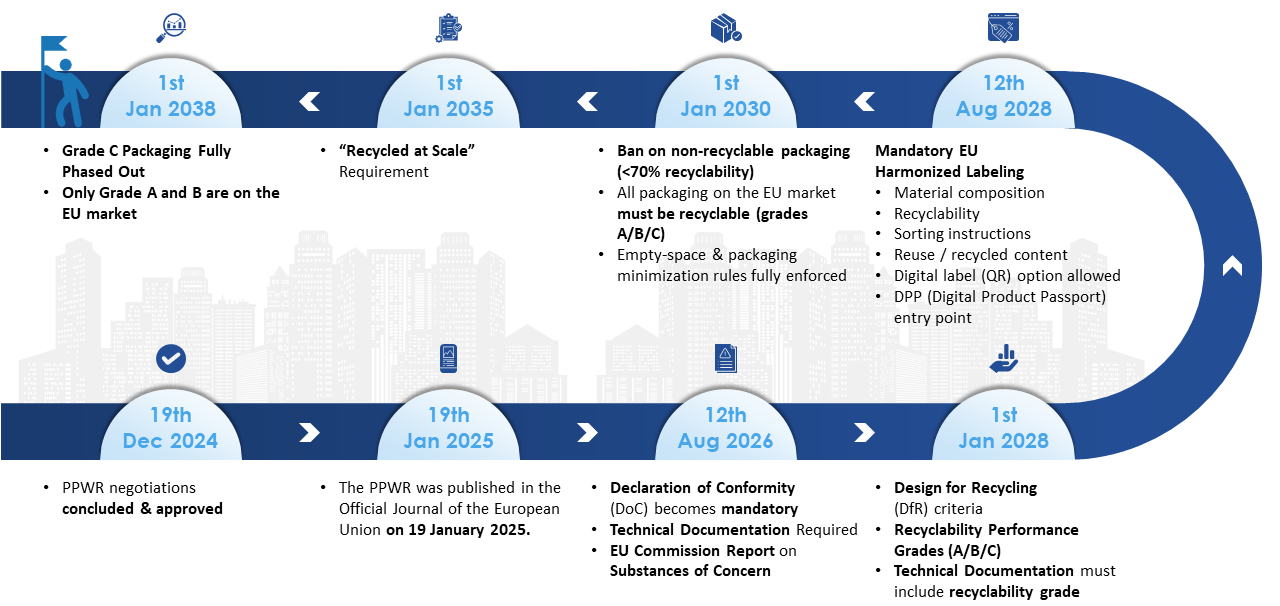
PPWR timeline and key dates
Who does PPWR affect?
PPWR affects all economic operators involved in placing packaging or packaged products on the EU market, regardless of whether the company is based inside or outside the EU. It applies across the packaging value chain, including manufacturers, suppliers, importers, distributors, fulfilment service providers, and producers under EPR obligations.
- OEMs / Manufacturers: Ensure compliance, prepare technical documentation, and issue DoC.
- Suppliers: Provide material data, declarations, and test evidence.
- Importers: Verify conformity before EU market placement.
- Distributors: Check required compliance, labelling, and registration information.
- Producers / Brand Owners: Manage EPR registration and reporting obligations.
- Fulfilment Providers: Ensure handling and dispatch do not affect compliance.
Why companies should pay attention?
PPWR introduces new requirements that impact how packaging is designed, sourced, documented, and managed across the value chain. Many organizations face challenges in obtaining accurate packaging data, ensuring supplier collaboration, and demonstrating compliance through technical documentation. Companies should assess:
- Packaging material composition
- Packaging minimization opportunities
- Recyclability performance
- Materials of concern (MoC) compliance
- Technical documentation readiness
- Supplier data availability and quality
PPWR compliance extends beyond packaging functions and requires collaboration across regulatory, sustainability, procurement, engineering, and supply chain teams. Organizations that start early can reduce compliance risks, improve data readiness, and streamline future reporting and conformity obligations.
How to prepare for PPWR (guidelines for manufacturer)?
Manufacturers can start with a PPWR Impact Assessment approach.
Step 1: Build a Packaging Inventory
Identify all packaging types used across products, markets, and suppliers.
Step 2: Assess Material Composition
Evaluate packaging materials for recyclability, recycled content, and restricted substances.
Step 3: Perform Gap Assessment
Compare current packaging practices against PPWR requirements and identify compliance gaps.
Step 4: Prioritize High-Risk Packaging
Focus first on:
- Complex multi-material packaging
- Plastic-intensive packaging
- High-volume SKUs
- Packaging with limited recyclability pathways
Step 5: Develop Compliance Roadmap
Create phased actions covering:
- Packaging redesign
- Supplier engagement
- Testing and validation
- Documentation updates
- Labelling changes
Step 6: Establish Governance and Monitoring
Track upcoming delegated acts, guidance documents, FAQs, and industry-specific requirements as the regulatory framework evolves. The European Commission continues to publish implementation guidance and FAQs to support industry adoption.
Frequently Asked Questions (FAQs)
Is PPWR mandatory?
Yes. PPWR is an EU regulation and applies directly across Member States without requiring national transposition.
Does PPWR apply to manufacturers outside Europe?
Yes. Any company placing packaged products on the EU market can be affected, regardless of where manufacturing takes place.
Does PPWR affect medical device manufacturers?
Yes. Medical device companies exporting to Europe must evaluate packaging compliance requirements, although certain medical packaging categories may have specific exemptions or considerations.
When should companies start preparing?
Immediately. Packaging redesign, supplier engagement, testing, and compliance documentation can take months or years depending on product complexity. The main application date is 12 August 2026.
What happens if my packaging is not compliant?
Non-compliant packaging may face market access challenges, enforcement actions, corrective measures, or increased compliance costs depending on applicable requirements and national enforcement practices.
Conclusion
PPWR is more than a regulatory compliance exercise. It is a catalyst for organizations to gain greater visibility into their packaging portfolio, strengthen supplier collaboration, and build a more resilient and sustainable packaging strategy. As compliance deadlines approach, companies that act early will be better positioned to address data gaps, minimize redesign efforts, optimize costs, and navigate evolving regulatory expectations with confidence. Those that delay may face increased compliance risks, operational challenges, and potential barriers to accessing the EU market. The time to start preparing is now.
Authors
Practice Manager | QARA
Tata Elxsi