Introduction
Software has fundamentally transformed the automotive industry. Over the past decade, Software-Defined Vehicles (SDVs) have evolved vehicles from static mechanical products into continuously advancing digital platforms capable of delivering over-the-air (OTA) updates, intelligent cockpit experiences, advanced driver assistance systems (ADAS), and connected mobility services.
Much of this transformation has been driven by software velocity, or the ability of OEMs to rapidly develop, validate, deploy, monitor, and continuously improve software-enabled vehicle functions. Faster release cycles, continuous feature enhancements, and richer digital experiences have become hallmarks of the first wave of SDVs.
However, as SDVs move beyond premium vehicles into mainstream, high-volume programs, the industry's priorities are beginning to evolve. The next competitive advantage may no longer come from releasing more features at a faster pace. Instead, it may stem from ensuring that software remains safe, secure, maintainable, and economically sustainable throughout a vehicle's lifecycle. In other words, the next era of SDVs could be defined by software trust.

For a closer look at this shift, Tata Elxsi’s Sundar Ganapathi, CTO- Transportation, unpacks how Japanese OEMs are rethinking the software-defined vehicle in this short film.
Customers increasingly expect vehicles to remain digitally relevant for a decade or more, while regulators demand stronger cybersecurity measures and more robust software update governance. At the same time, OEMs must manage growing software complexity while controlling lifecycle costs across millions of vehicles operating in diverse market environments. The challenge is no longer building software-defined vehicles. It is building software-defined vehicles that customers, regulators, and businesses can trust throughout their operational life.
While China and the United States continue to set the pace in software velocity, AI-enabled experiences, and digital ecosystems, Japan is pursuing a distinct path. Rather than competing solely on software velocity or attempting to replicate the first wave of SDV innovation, Japan is focusing on shaping the next phase of the software-defined vehicle era, where software is engineered not only to evolve rapidly but also to evolve responsibly throughout the vehicle lifecycle.
Beyond Feature Velocity: Trust Becomes the New Competitive Differentiator
The first wave of SDVs rewarded software velocity. Chinese manufacturers demonstrated how rapidly software could reshape the ownership experience through frequent OTA updates, AI-enabled cockpit capabilities, and continuously evolving digital services. At the same time, technology companies and digital-native OEMs accelerated customer expectations around connectivity, personalization, and software-first experiences. These developments have fundamentally elevated the industry's software ambitions. Organizations capable of shortening software release cycles and responding quickly to customer expectations gained a significant competitive advantage. That momentum is unlikely to slow. Software velocity will remain essential to the future of mobility.
Yet software innovation presents a fundamentally different engineering challenge from traditional vehicle development. Unlike smartphones, vehicles are expected to remain operational for more than a decade. Every software feature introduced today creates a long-term engineering commitment encompassing cybersecurity, validation, software updates, regulatory compliance, and lifecycle support. Software is no longer merely a product delivered at launch. It becomes an ongoing operational responsibility that must be maintained, secured, validated, and continuously improved across millions of vehicles throughout their lifecycle. The next competitive advantage is therefore shifting from releasing software faster to sustaining software responsibly at scale.
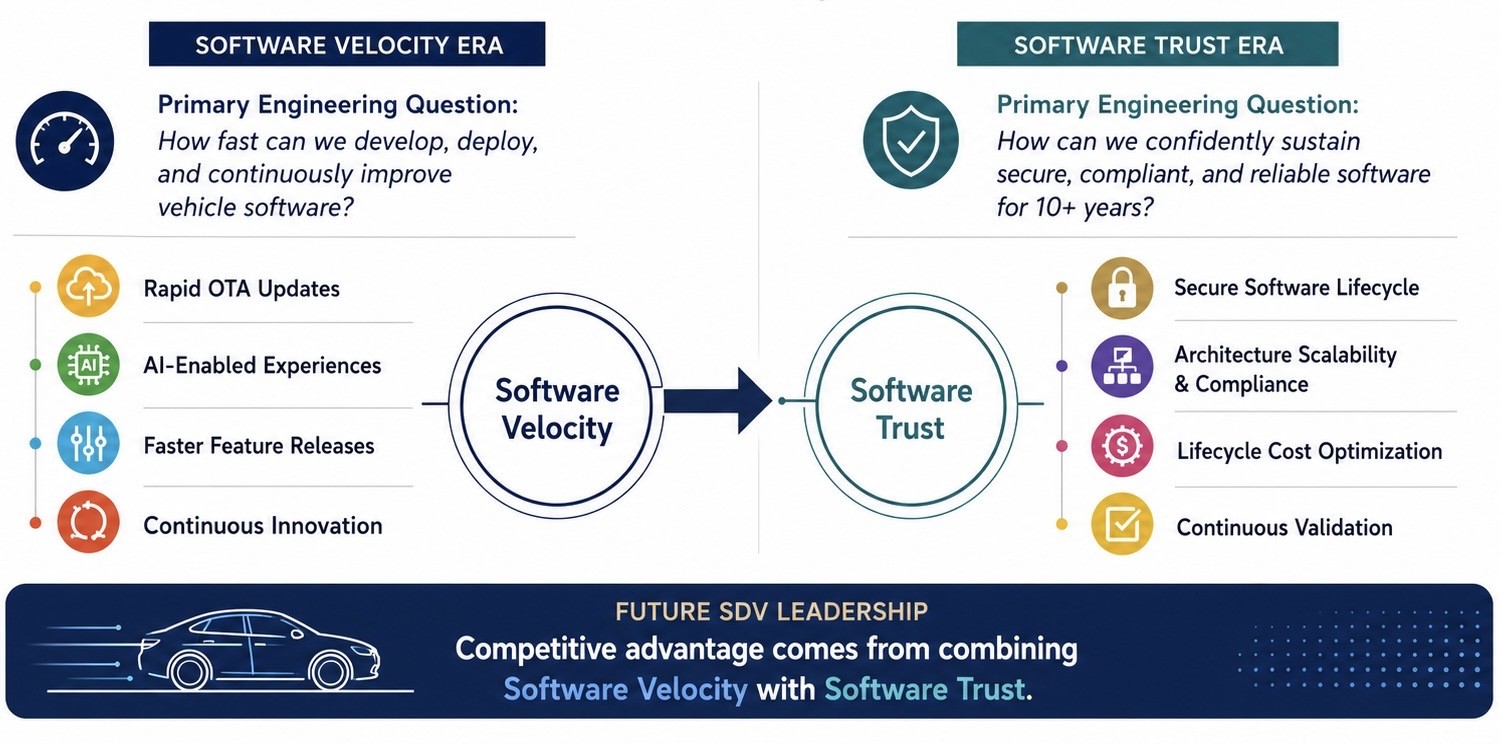
Figure 1: Evolution of SDV from SW Velocity to SW Trust
This broader perspective can be described as software trust. A vehicle may contain highly sophisticated software yet still face challenges related to costly updates, fragmented architectures, lengthy validation cycles, or evolving cybersecurity risks throughout its lifetime. Software trust therefore extends beyond software quality. It reflects an organization's ability to manage software safely, securely, and economically across the entire vehicle lifecycle. Achieving that trust depends on multiple engineering capabilities working together rather than on any single technology or process.
The Foundations of Software Trust
One way to understand this evolution is through what can be described as the SDV Trust Stack: a set of interconnected capabilities that collectively determine whether software can evolve safely, efficiently, and sustainably over time.
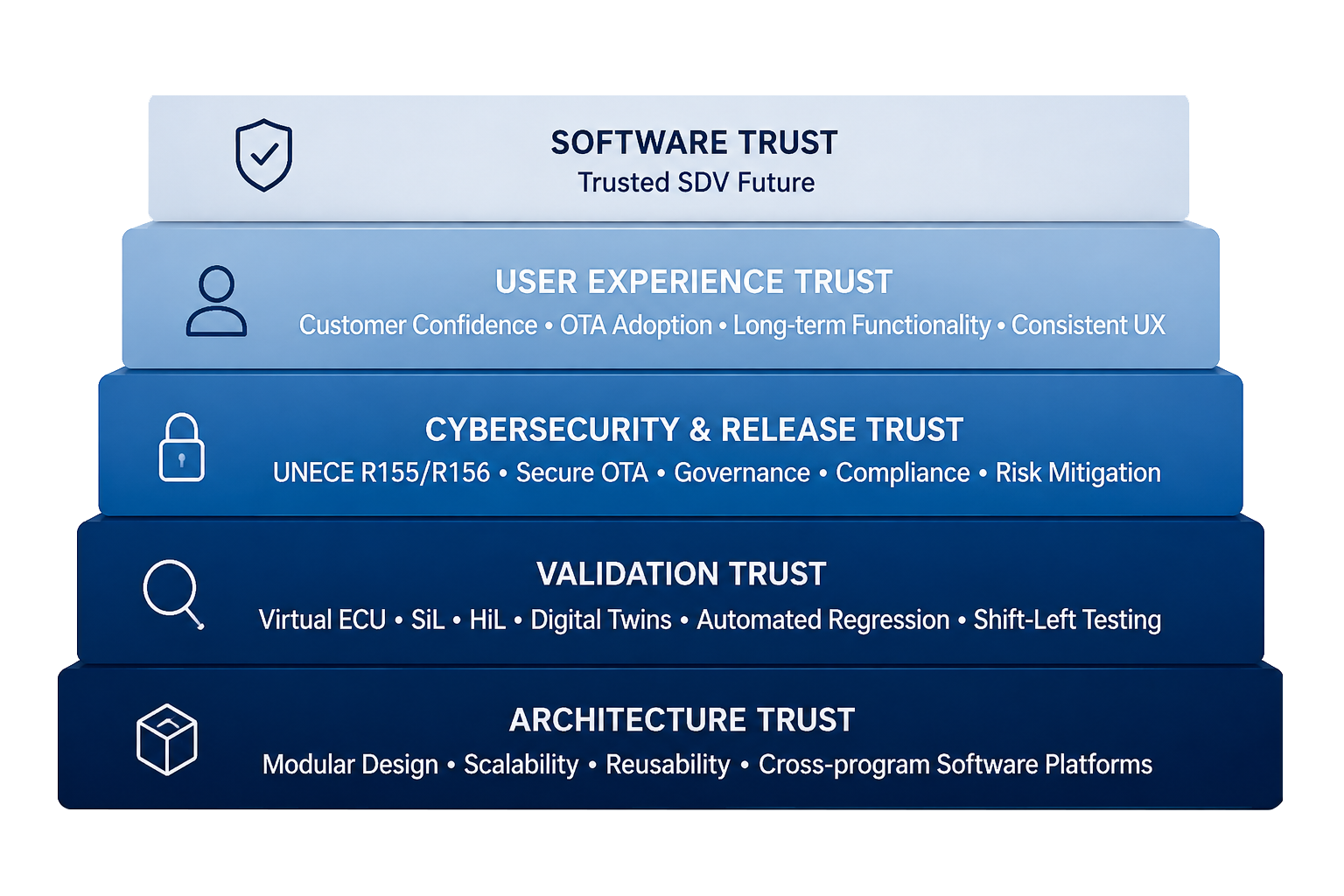
Figure 2: Software Trust Stack
- Architecture Trust ensures that software platforms remain modular, reusable, and scalable across multiple vehicle programs without introducing unnecessary complexity.
- Validation Trust enables continuous software verification through virtualization, Software-in-the-Loop (SiL), Hardware-in-the-Loop (HiL), digital twins, and automated regression testing, well before vehicles reach production.
- Cybersecurity and Release Trust focus on secure software update management, compliance with evolving cybersecurity regulations such as UNECE R155 and R156, and disciplined release governance that minimizes operational risk.
- Lifecycle Cost Trust recognizes that every software feature carries years of maintenance, validation, cloud operations, and support costs that must be managed alongside innovation.
- User Experience Trust ensures that software continues to deliver meaningful customer value long after the initial purchase, rather than becoming obsolete or difficult to maintain.
Viewed collectively, the SDV Trust Stack illustrates a fundamental shift in automotive software engineering. Competitive advantage is no longer defined solely by how quickly software can be developed, but by how confidently it can be deployed, maintained, and continuously improved throughout the vehicle lifecycle.
It is precisely this transition, from viewing software as a product to recognizing it as a long-term engineering responsibility, that creates a compelling opportunity for engineering philosophies centered on quality, lifecycle thinking, and disciplined systems integration.
Japan's Opportunity in the Next Phase of SDVs
As the SDV industry matures, Japan's opportunity extends beyond software velocity. China and the United States continue to lead in areas such as rapid OTA deployment, AI-enabled cockpit innovation, software monetization models, and large-scale data ecosystems. Japan's role, however, lies elsewhere.
For decades, Japanese automakers have differentiated themselves through engineering discipline, safety, quality, and lifecycle thinking. Vehicles have been designed not merely to perform well at launch but to remain dependable throughout long ownership cycles. As software becomes the defining element of vehicle value, these engineering principles are emerging as powerful competitive differentiators.
Japan's advantage is not that it already leads in every aspect of SDV development. Rather, its longstanding philosophy of customer-value-driven engineering and lifecycle reliability may become increasingly important as SDVs scale across millions of vehicles. This direction is also reflected in Japan's broader Mobility DX Strategy, which identifies Software-Defined Vehicles, mobility services, and data utilization as strategic priorities while outlining an ambition to strengthen Japan's global competitiveness in the SDV era.
This shift is already visible across Japan's automotive ecosystem. Toyota's Arene platform aims to establish a common software foundation for future vehicles. Honda's ASIMO OS advances software-centric vehicle architectures, while Suzuki's SDV Right initiative emphasizes virtualization, cloud-based engineering, and scalable software development. Collectively, these initiatives reflect a broader industry transition from delivering software features to building the engineering foundations required for long-term software-defined mobility.
Equally important is Japan's willingness to complement in-house development with strategic partnerships, recognizing that future SDV platforms will increasingly depend on shared technologies, open ecosystems, and industrialized software engineering rather than isolated development efforts. Japan's opportunity, therefore, is not to imitate consumer technology companies. Instead, it is demonstrated that the next era of SDVs will be defined not only by faster software but also by more trustworthy software. This capability becomes especially significant as SDVs expand beyond premium segments, where software must deliver not only innovation but also affordability, scalability, and long-term value across increasingly diverse global markets.
Designing SDVs for Best-Cost and High-Growth Markets
The next phase of SDV adoption will increasingly be shaped by markets beyond traditional premium vehicle segments. Global South markets, including India, Southeast Asia, Latin America, the Middle East, and Africa, represent significant opportunities for software-defined mobility. However, they also introduce engineering realities that differ substantially from those of mature premium markets. Vehicles often remain in service for longer periods; connectivity quality can vary considerably, and cost sensitivity remains high. Digital services must therefore deliver tangible customer value rather than technology for its own sake.
As a result, SDV architectures designed exclusively for premium markets cannot simply be replicated globally. Instead, OEMs require market-aligned software architectures that balance innovation with affordability. In these markets, successful SDVs increasingly depend on:
- Right-sized compute platforms that avoid unnecessary hardware costs while preserving upgradeability.
- Software architectures that are resilient to variable connectivity, enabling reliable updates even under inconsistent network conditions.
- Modular feature deployment that allows regional customization without requiring entirely separate software platforms.
- Long-term maintainability, recognizing that vehicles may remain operational for well over a decade.
- Practical software monetization models that prioritize customer-relevant services over feature proliferation.
This represents a fundamentally different philosophy from premium-focused SDV development. Success is no longer measured by the number of digital features deployed. Instead, it is defined by the ability to deliver the right software capabilities at the right cost, throughout the vehicle lifecycle
Software Lifetime Cost Is Becoming a Strategic Metric
As SDVs mature, software economics is becoming just as important as software capability. Every feature introduced into production creates recurring operational commitments that extend far beyond initial development.
- Software update management
- Cybersecurity monitoring
- Cloud infrastructure operations
- Supplier integration
- Regression testing
- Compliance management and updates
- Field issue analytics
- Customer support
Together, these activities define what can be described as the software lifetime cost of an SDV platform. A feature that is inexpensive to develop can become costly to maintain if it requires continuous cybersecurity monitoring, frequent validation, extensive cloud infrastructure, ongoing regulatory updates, or significant field support. Conversely, software architectures designed for reuse, automation, modularity, and scalable validation can substantially reduce ownership costs over the vehicle lifecycle.
This shift is reshaping how OEMs evaluate software investments. Future vehicle programs will increasingly need to consider not only what software can do at launch, but also what it will cost to sustain, secure, validate, and evolve over a decade or more. For OEMs operating across millions of vehicles, these recurring costs have a significant impact on long-term profitability. Future-ready software architectures must therefore optimize not only feature innovation but also maintainability, validation of reuse, release of governance, and lifecycle efficiency. Ultimately, sustainable software innovation depends as much on operational excellence as it does on engineering creativity.
Why Virtualization and Validation Are Becoming Strategic
As software complexity continues to increase, traditional validation approaches alone are no longer sufficient. Virtual ECUs, Software-in-the-Loop (SiL), Hardware-in-the-Loop (HiL), cloud-native validation environments, digital twins, and automated regression testing are fundamentally transforming how vehicle software is developed and validated. The objective is not simply to accelerate development, but to build confidence earlier in the development lifecycle.
Shift-left validation enables engineering teams to identify integration issues before production hardware becomes available, reducing downstream risk while improving software maturity throughout the development process. This industrialized approach is becoming increasingly critical as software release cycles compress and regulatory expectations around cybersecurity; functional safety, and software update governance continue to expand.
Through initiatives such as the Suzuki–Tata Elxsi Cloud HiL Center and solutions such as the Tata Elxsi AVENIR software suite, Tata Elxsi is helping customers industrialize validation by enabling cloud-native development, virtual validation, reusable testing frameworks, and connected digital engineering environments. In the future, validation capability may become just as important as software development capability itself. Organizations that can validate software continuously and at scale will be better positioned to deliver both software velocity and software trust.
Why Japan and India Form a Natural SDV Partnership
As SDVs expand globally, the combination of Japanese engineering discipline and India's software capabilities presents a compelling model for the next phase of automotive innovation. Japan brings decades of expertise in product engineering, manufacturing excellence, quality management, functional safety, and lifecycle thinking. India complements these strengths with deep software engineering capabilities, cloud-native development expertise, virtualization, large-scale validation, and cost-conscious innovation.
Perhaps more importantly, India represents one of the world's most valuable environments for developing software-defined mobility under real-world constraints. Vehicles must operate across diverse connectivity conditions; ownership cycles tend to be longer, and customers prioritize value and reliability over novelty. These realities have enabled engineering teams to optimize software architectures for scalability, resilience, and affordability. Increasingly, these are the same characteristics required across many high-growth automotive markets.
Together, Japan and India offer more than engineering capacity. They provide a complementary combination of capabilities that can help industrialize trusted software-defined mobility at a global scale, balancing software innovation with quality, affordability, and long-term lifecycle sustainability.
Industrializing Software Trust
As SDVs continue to evolve, OEMs increasingly need partners capable of supporting software throughout its lifecycle rather than simply accelerating development. This requires expertise spanning cloud-native software engineering, virtualization, validation automation, cybersecurity, lifecycle governance, and reusable software platforms.
Tata Elxsi's approach reflects this broader industry shift. Through Tata Elxsi AVENIR and its cloud-native engineering and validation ecosystem, Tata Elxsi helps OEMs move beyond rapid software releases toward software that is safe, validated, secure, and lifecycle-ready. Industrializing software trust requires more than engineering talent. It demands repeatable development processes, scalable validation, disciplined release governance, and robust lifecycle management that can be applied consistently across vehicle programs and geographies. Tata Elxsi has invested in building these industrialized engineering capabilities, enabling customers to scale software development with greater confidence, consistency, and operational efficiency.
As SDVs become increasingly complex, the ability to industrialize these capabilities may prove just as valuable as the ability to develop new software features. Tata Elxsi's experience across Japanese OEM programs and best-cost markets positions it uniquely to bridge Japanese quality expectations with India's software scale, engineering expertise, and development agility.
Looking Ahead
The first wave of Software-Defined Vehicles (SDVs) demonstrated what software can enable. The next wave will determine how responsibly software can evolve across millions of vehicles, multiple markets, and decades of ownership. China and the United States have shown what is possible when software innovation moves at extraordinary speed. Japan now has the opportunity to demonstrate something equally important: how software can remain trusted throughout the vehicle lifecycle.
For global and best-cost markets alike, future SDV success will depend not only on intelligent features but also on architectures that are modular, validated, secure, maintainable, and economically sustainable. This is where the convergence of Japanese engineering philosophy and India's software capabilities becomes particularly compelling. Together, they can help shape a new generation of Software-Defined Vehicles designed not only for innovation but also for long-term trust.
As OEMs navigate this transition, the organizations best positioned to create value may not necessarily be those that release software the fastest. Instead, they will be those that can sustain, validate, secure, and continuously evolve software with confidence throughout the vehicle lifecycle.
Author
Marketing Lead – Transportation Business
Tata Elxsi