

Blog
Software-Defined Machines: Redefining the Future of Off-Highway Equipment
Navigation
Navigation- Beyond Mechanical Machines: The Rise of Software-Defined Equipment
- Understanding Software-Defined Machines
- Why Software-Defined Machines Are Gaining Momentum
- Architecture Transformation: The Foundation of SDMs
- Opportunities Created by Software-Defined Machines
- Artificial Intelligence and Digital Twins: The Intelligence Layer
- Challenges in the Journey Toward Software-Defined Machines
- Tata Elxsi Avenir: Accelerating the Software-Defined Machine Journey
- The Road Ahead
Beyond Mechanical Machines: The Rise of Software-Defined Equipment
The off-highway industry has always been built on engineering excellence. For decades, success was determined by the strength of a machine's mechanical systems, the efficiency of its hydraulics, the durability of its structures, and the reliability of its powertrain. Whether in construction, mining, agriculture, forestry, or material handling, OEMs competed by building machines that could operate longer, lift more, dig deeper, and withstand the harshest environments.
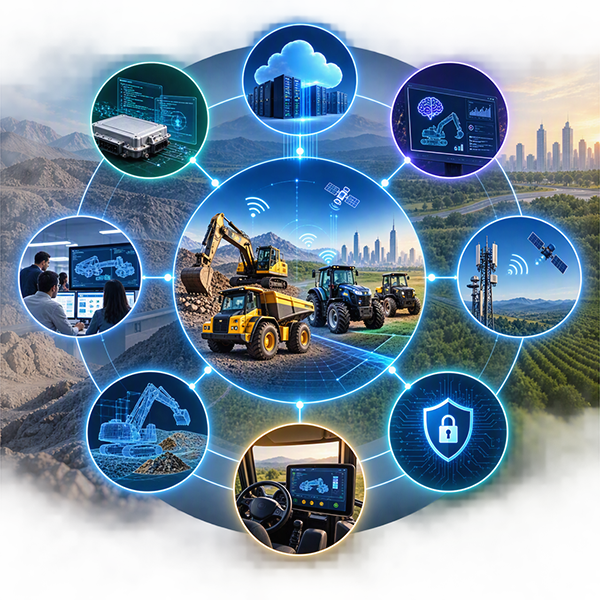
Today, however, the industry is at the beginning of a profound transformation. While mechanical innovation remains essential, a new layer of differentiation is emerging: software.Modern off-highway equipment is evolving from standalone mechanical assets into connected, intelligent platforms capable of learning, adapting, and continuously improving throughout their operational life. Similar to how Software-Defined Vehicles (SDVs) are reshaping the automotive industry, Software-Defined Machines (SDMs) are becoming the foundation for the next generation of off-highway equipment.
The shift is being driven by the convergence of connectivity, electrification, automation, artificial intelligence, cloud computing, and digital engineering. Increasingly, machine performance is no longer determined solely by hardware specifications. Instead, software is becoming the orchestrator that controls machine behavior, optimizes operations, enhances safety, and enables entirely new business models. For OEMs, software-defined machines represent an opportunity to accelerate innovation and create long-term customer value. For fleet operators, they offer unprecedented visibility, uptime, productivity, and flexibility. More importantly, they provide a pathway toward autonomous, intelligent, and sustainable off-highway operations.
Understanding Software-Defined Machines
A Software-Defined Machine is an equipment platform in which functionality, performance, and operational capabilities are increasingly governed by software rather than dedicated hardware. Unlike traditional machines where features are fixed once the equipment leaves the factory, software-defined machines can evolve throughout their lifecycle through updates, configurable features, and intelligent services.
In a conventional software-defined machine architecture, introducing a new machine capability often requires the addition or modification of hardware components. In contrast, a software-defined architecture allows manufacturers to deploy enhancements remotely, unlock new functions, optimize performance parameters, and deliver new customer experiences through software updates.
This transformation is particularly important in off-highway applications because machines often remain in operation for ten to twenty years. The ability to continuously improve equipment through software enables OEMs to extend product relevance, enhance asset value, and maintain competitiveness throughout the lifecycle of the machine. A software-defined machine is not simply a connected machine. It is a machine built around a digital-first architecture where software becomes a core product component, influencing everything from machine control and diagnostics to autonomy and user experience.
Why Software-Defined Machines Are Gaining Momentum
Several industry trends are accelerating the adoption of software-defined architectures across the off-highway sector. The first is the growing complexity of machines themselves. Today's excavators, mining trucks, wheel loaders, tractors, and harvesters incorporate sophisticated electronic systems, advanced sensors, telematics modules, vision systems, and intelligent control algorithms. Managing these increasingly complex interactions through traditional distributed architectures is becoming difficult. At the same time, autonomy is moving from research projects into real-world deployments. Modern equipment is expected to support machine guidance, obstacle detection, operator assistance features, autonomous working modes, and collaborative fleet operations. These capabilities are fundamentally software-driven and require centralized computing platforms capable of managing enormous volumes of sensor data in real time.
Electrification is another major catalyst. Battery-electric and hybrid off-highway equipment introduces new requirements for energy management, thermal optimization, charging strategies, and power distribution. Software plays a critical role in ensuring that electric systems operate efficiently while maximizing productivity and extending component life. Customer expectations are also evolving. Equipment owners increasingly expect experiences similar to those delivered by connected consumer devices and modern vehicles. They want remote diagnostics, predictive alerts, performance monitoring, software upgrades, and digital services that improve operational outcomes without requiring major hardware investments.
Together, these trends are pushing manufacturers toward architectures where software becomes as strategically important as mechanical engineering.
Architecture Transformation: The Foundation of SDMs
One of the most significant changes associated with software-defined machines is the evolution of machine electronics architecture. Most traditional off-highway equipment relies on numerous Electronic Control Units (ECUs), each responsible for a dedicated function. While effective in the past, these architectures create complexity as software volumes increase and machine intelligence expands.
Software-defined machines are increasingly moving toward centralized and domain-based architectures. Instead of having dozens of isolated control units operating independently, multiple functions are consolidated into high-performance computing platforms. This transition delivers several benefits. It simplifies software deployment, reduces wiring complexity, improves scalability, and enables better coordination between machine subsystems. More importantly, centralized architectures create the foundation required for autonomous functions, AI-driven analytics, and future software services.
Many OEMs are now adopting Service-Oriented Architectures (SOA), where machine functions are delivered as software services that can communicate seamlessly across systems. This approach reduces integration complexity and enables faster deployment of new capabilities across multiple product platforms.
Opportunities Created by Software-Defined Machines
Perhaps the most exciting aspect of software-defined machines lies in the opportunities they create for both manufacturers and equipment operators. For OEMs, software creates an entirely new revenue model. Historically, revenues were generated through equipment sales, replacement parts, and service contracts. Software-defined architectures enable recurring revenue streams through subscription services, feature-on-demand licensing, advanced analytics packages, autonomous operation modules, and fleet management solutions.
A machine delivered today can continue generating value for both the customer and manufacturer for years through software enhancements and digital services. Operational productivity also improves significantly. Intelligent software continuously optimizes machine behavior based on operating conditions, workload requirements, environmental factors, and operator inputs. Hydraulic systems can automatically adapt to workload demands. Powertrain controls can maximize efficiency. Machine settings can be optimized dynamically to improve performance while reducing energy consumption. Another major advantage is predictive maintenance. Traditionally, maintenance activities have followed predefined schedules or have been triggered by component failure. Software-defined machines leverage data analytics, machine learning, and condition-monitoring systems to identify emerging issues before breakdowns occur.
This proactive approach helps reduce unplanned downtime, optimize maintenance schedules, and improve equipment availability. For large mining, construction, and agricultural fleets, even small improvements in machine uptime can generate substantial business value.
Artificial Intelligence and Digital Twins: The Intelligence Layer
Artificial intelligence is rapidly becoming a key enabler of software-defined machines.
Modern equipment generates vast amounts of operational data from sensors, controllers, cameras, radar systems, GNSS receivers, and telematics platforms. AI algorithms can transform this raw data into actionable insights that improve productivity, efficiency, and safety.
Machine learning models can identify early indicators of component wear, predict system failures, optimize fuel consumption, and recommend maintenance actions. Advanced AI systems can also support autonomous navigation, path planning, obstacle recognition, and intelligent work cycle optimization. Alongside AI, digital twins are emerging as a foundational capability for next-generation off-highway equipment. A digital twin creates a virtual representation of a physical machine, enabling engineers and operators to monitor performance, test software updates, simulate operating conditions, and evaluate potential improvements before deployment.
By combining real-world machine data with simulation environments, digital twins help accelerate product development, reduce validation time, improve operational insights, and support continuous optimization throughout the equipment lifecycle. As software complexity increases, digital twins will become an essential component of software-defined machine ecosystems.
Challenges in the Journey Toward Software-Defined Machines
Despite the opportunities, the transition to software-defined machines is not without challenges. One of the biggest obstacles is the presence of legacy architectures. Many existing machine platforms were designed long before software became a strategic differentiator. These systems often rely on fragmented electronics architectures, proprietary interfaces, and hardware-specific implementations that make modernization difficult.
Cybersecurity is another growing concern. As machines become increasingly connected to cloud platforms, enterprise systems, and external networks, they become potential targets for cyber threats. Unauthorized access, software tampering, operational disruptions, and data breaches can create significant operational and financial risks. To address these challenges, manufacturers must embed cybersecurity throughout the product development lifecycle. Secure boot mechanisms, software authentication, encrypted communication, intrusion detection, and vulnerability management are becoming critical requirements.
Software complexity itself presents another challenge. Modern machines may contain millions of lines of code distributed across multiple platforms and applications. Managing software versions, validating updates, ensuring compatibility, and maintaining quality require new engineering practices and development methodologies. Functional safety is equally important. Unlike consumer electronics, off-highway equipment operates in environments where failures can have serious consequences. Machines must continue to comply with safety requirements even as software evolves through updates and feature deployments.
The industry's talent landscape is also changing. Organizations that have historically focused on mechanical and hydraulic expertise must now invest in software engineers, system architects, cybersecurity specialists, data scientists, and AI experts to support the transition.
Tata Elxsi Avenir: Accelerating the Software-Defined Machine Journey
As off-highway OEMs accelerate their shift toward software-centric architectures, they require platforms that can simplify complexity and accelerate deployment. This is where Tata Elxsi's Avenir™ plays a critical role.
Avenir™ is Tata Elxsi's software-defined mobility platform designed to help manufacturers build, deploy, and manage next-generation software-defined products. While its foundation lies in software-defined mobility, its modular and scalable architecture makes it highly relevant for off-highway equipment manufacturers pursuing connected, autonomous, electric, and intelligent machine strategies. Avenir helps OEMs transition from fragmented electronics architectures to service-oriented, software-centric ecosystems. It supports centralized computing strategies, middleware integration, software lifecycle management, and scalable deployment frameworks that are essential for software-defined machines.
One of the key advantages of Avenir is its ability to support secure over-the-air software updates. Instead of relying on physical service interventions, OEMs can remotely deploy software enhancements, activate new features, address issues, and maintain fleet-wide consistency. This significantly reduces operational costs while improving customer experience. Avenir also enables seamless integration between machines, cloud platforms, dealers, operators, and enterprise systems. This connectivity provides the foundation for predictive maintenance, fleet intelligence, remote diagnostics, and data-driven decision-making. Cybersecurity is embedded within the platform's design philosophy, helping manufacturers address evolving security requirements while supporting compliance and operational resilience.
Most importantly, Avenir enables OEMs to focus on innovation rather than repeatedly solving infrastructure challenges. By providing reusable frameworks, scalable architectures, and ready-to-deploy capabilities, it accelerates the software-defined machine journey while reducing development effort, risk, and time-to-market.
The Road Ahead
The future of off-highway equipment will be defined by the successful convergence of hardware and software. Mechanical excellence will continue to remain fundamental, but software will increasingly become the differentiator that determines machine intelligence, user experience, operational efficiency, and business value.
Software-defined machines are laying the groundwork for autonomous construction sites, intelligent mining operations, precision agriculture, and highly connected industrial ecosystems. They are enabling machines that can continuously improve, adapt to changing environments, and deliver value far beyond their original specifications. The transition is not simply about adding software to existing products. It requires a fundamental rethinking of architectures, engineering processes, organizational capabilities, and business models. Those manufacturers that embrace this transformation early will be best positioned to lead the industry's next phase of innovation.
As connectivity, electrification, automation, artificial intelligence, and digital engineering continue to mature, software-defined machines will move from being a strategic aspiration to becoming the standard foundation of future off-highway equipment. The industry's next competitive advantage will not be determined solely by mechanical capability, but by the intelligence, flexibility, and continuous innovation that software makes possible.