


Blog
Why the German Mittelstand’s Next Engineering Advantage Will Come From India
Blog
BlogExecutive summary
The German Mittelstand does not have an engineering-quality problem. It has a capacity and speed problem. Specialist talent is harder to secure, software content is increasing across products, regulatory obligations are expanding and global competitors are moving faster. India offers the most mature environment to add engineering depth at scale without weakening the product leadership, customer intimacy and domain expertise that should remain anchored in Germany.
The right objective is not to create a low-cost remote office. It is to build a dedicated capability that can take ownership of lifecycle engineering, verification, embedded software, digital platforms, AI-enabled engineering and product localisation. The strongest starting point is one clearly defined product area, supported by German leadership, secure governance and measurable business outcomes.
India can help Mittelstand companies make this move with lower execution risk. Indian ER&D service companies combines product design, domain engineering, embedded systems, software, cloud, data, AI, validation, cybersecurity and regulatory capabilities with experience in setting up and operating dedicated engineering centres. The recommended path is simple: align on the most important capability bottleneck, launch a focused nucleus team in India, prove value against German quality gates and scale towards end-to-end product ownership.
The Strategic Imperative
German Mittelstand companies have built their reputation on engineering depth, product quality and long-term customer trust. Those strengths remain intact. But the operating environment has changed. Software is becoming part of every machine, vehicle and medical device. Regulatory work is increasing. Specialist talent in Germany is harder to find. Product cycles are getting shorter.
Waiting for these pressures to ease is not a strategy. The practical response is to widen the engineering base while keeping product direction, quality and intellectual property under firm control. India is the strongest location to do that at meaningful scale.
More than 80 German companies already operate over 150 GCC units in India, with more than 130,000 professionals. The Mittelstand cohort alone includes more than 25 centres and over 7,300 engineers. The move is already under way. The question is how to enter well, build trust quickly and scale without creating unnecessary complexity.
Why India, Why Now
Talent that matches the new product agenda
Mittelstand companies need embedded software, cloud, data, AI, electronics, cybersecurity, UX, verification and regulatory engineering. India offers these capabilities in one established ecosystem.
More engineering capacity for the same investment
The right comparison is cost-to-skill, not hourly rate. India makes it possible to build larger, more specialised and more continuous product teams.
A faster path to software-defined products
Connected platforms, OTA updates, digital twins, predictive maintenance and AI-enabled engineering require permanent teams. A well-designed India centre provides continuity.
Capacity to absorb regulatory work
A dedicated India team can handle product security, documentation, traceability, validation and lifecycle obligations without diverting every senior expert in Germany.
A base closer to growth markets
An India centre brings the product organisation closer to India and other emerging markets, making localisation and regional variants faster and better informed.
From German engineering strength to scalable global capability
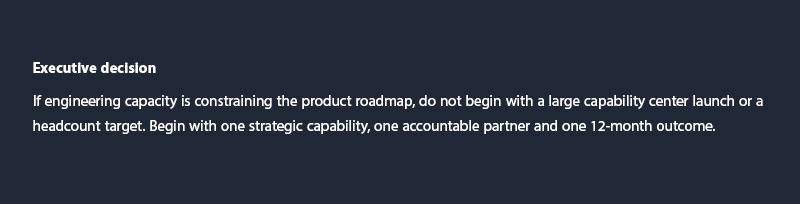
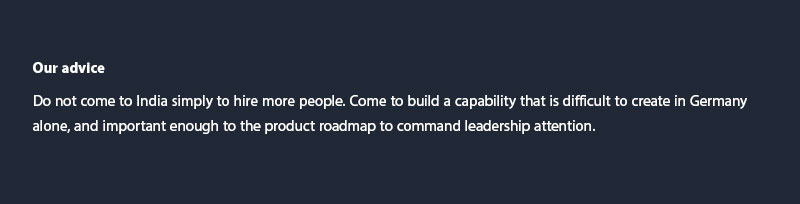
For a Mittelstand company, establishing an engineering centre in India should not begin with a headcount target. It should begin with a product constraint: a platform that needs to move faster, a software capability that is difficult to build in Germany, a regulatory workload consuming senior engineering capacity, or an emerging market that requires faster localisation.
Tata Elxsi helps customers convert these constraints into a focused Global Engineering Centre. The approach starts by defining the centre’s mandate across five dimensions: product portfolio, programme scope, talent mix, delivery locations and commercial model. The initial scope may cover lifecycle engineering, embedded software, verification and validation, customer applications or a specific product module. As delivery stabilises, the centre can expand into core platforms, advanced R&D, digital technologies and global product ownership.
In the GCC context, the Global Engineering Center (GEC) is the product-engineering core: a dedicated organisation designed around engineering outcomes rather than a broad shared-services mandate.
The centre is supported by Tata Elxsi’s wider engineering ecosystem, including design studios, technology practices, laboratories, delivery centres, academic relationships and specialist partners. This provides access to capabilities across embedded software, hardware, cybersecurity, AI, IoT, design, test automation and process assurance. A core-and-flex talent model maintains essential product knowledge while allowing teams to scale with programme demand.
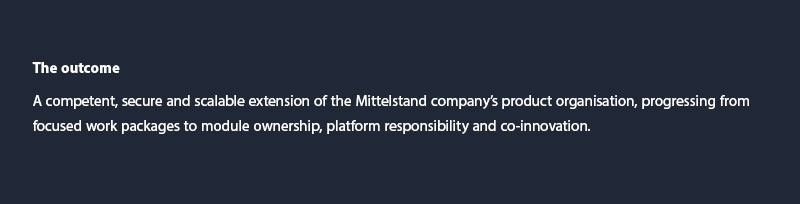
The GEC is integrated into the customer’s global engineering organisation through defined governance, SLAs, KPIs, quality measures and regular business reviews. German product leadership and engineering standards remain central, while Tata Elxsi adds the capacity, digital skills and execution speed required to compete globally.
Tata Elxsi's Mittelstand Global Engineering Centre (GEC) Model
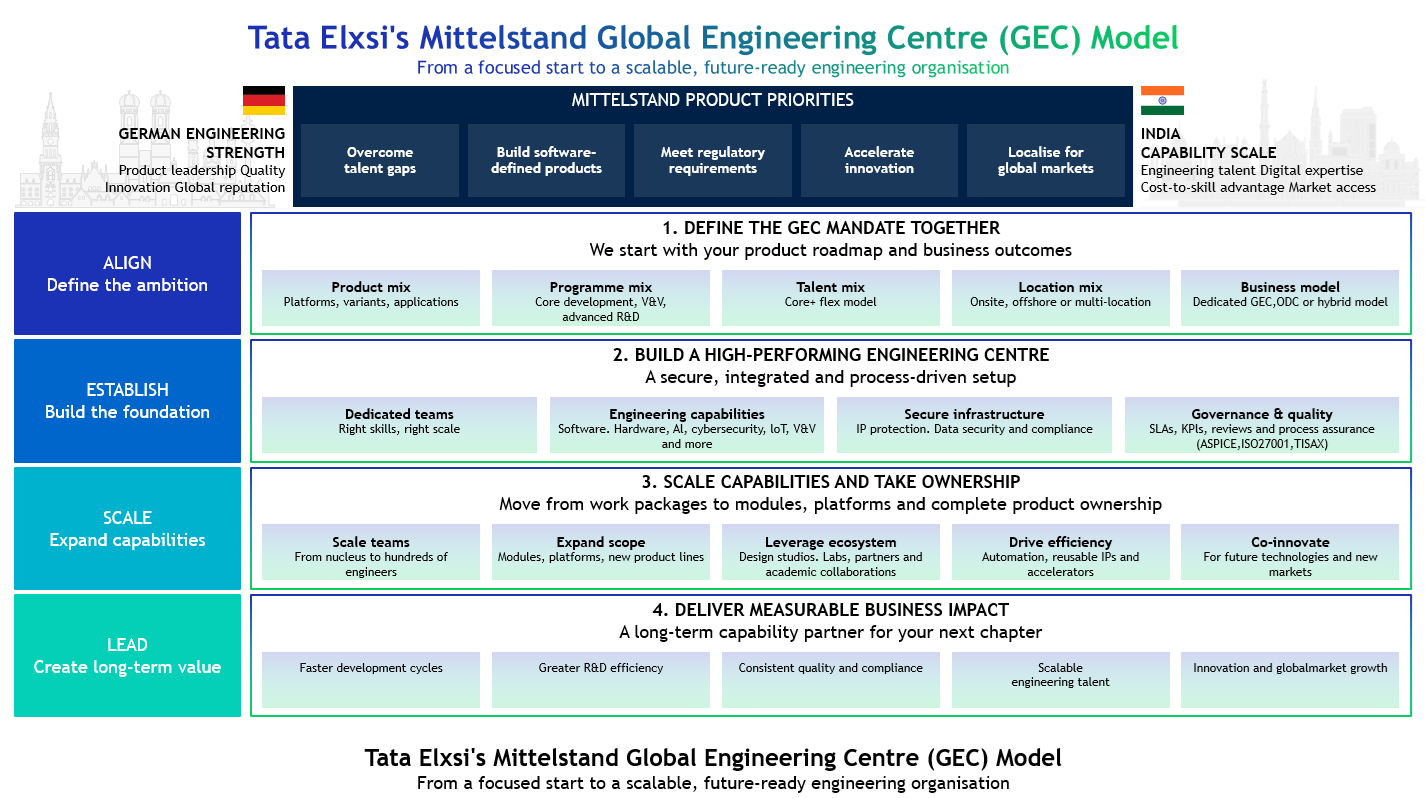 Figure 1. Tata Elxsi helps Mittelstand customers define the mandate, establish the engineering foundation, scale capabilities and deliver measurable business impact.
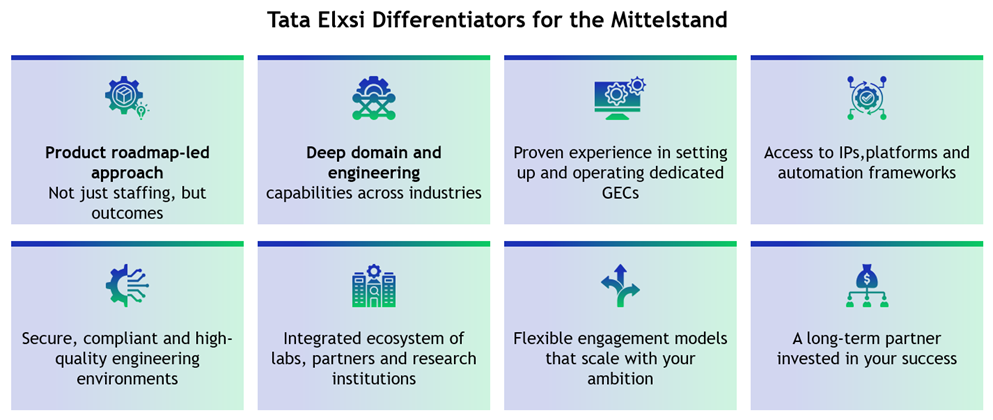
Tata Elxsi Differentiators for the Mittelstand
Author