

TEDAx Nexus: AI-Powered Data Analytics & Intelligence Platform
Transform enterprise data into action with TEDAx Nexus — Tata Elxsi's unified, AI-powered data analytics and intelligence platform for real-time decision-making.
Request a DemoIntroduction
Enterprise data is often scattered across applications, operational systems, documents, and databases. This fragmentation limits visibility and slows action. It also makes it harder to establish the reliable data foundation needed for analytics and AI.
Designed for data-intensive operations across automotive, media, and telecommunications, the AI-powered data analytics platform can improve operational efficiency by up to 20%, resolve issues up to 50% faster, and reduce operational costs by up to 40%
TEDAx Nexus addresses these challenges as an AI-powered data and analytics platform that brings together data engineering, advanced analytics, machine learning, and intelligent agents within a unified Data Lakehouse ecosystem.
It's cloud-agnostic architecture integrates with existing systems. Data profiling, quality, and governance controls support requirements under the EU Data Act, GDPR, CCPA, HIPAA, SOC 2, and ISO 27001.
Key Features of the platform

Data & AI Lakehouse
Unifies data from multiple sources, creating a trusted foundation for analytics, machine learning, and intelligent agents.

Conversational Analytics
Enables natural-language data exploration and automated documentation, making data and model information easier to understand.

Predictive Analytics & Anomaly Detection
Combines predictive analytics, model monitoring, and drift detection to identify risks before they disrupt operations.

Self-Service Business Intelligence
Provides a no code data analytics platform experience for creating dashboards, reports, and AI-assisted analytical workflows.

Domain-Specific AI Agents
Completes multi-step analysis across industries and business functions. Recommendations are tailored to each requirement and priority.

Intelligent Automation
Automates data processing, model operations, and workflows to reduce manual effort and improve operational resilience.

Operational Visibility
Connects events, performance signals, model health, and process data to support earlier action and faster response.

Cloud-Agnostic Deployment
Supports public, private, hybrid, and on-premises deployments across AWS, Azure, Google Cloud, and enterprise infrastructure.
User Types
From Enterprise Data to Intelligent Action
From Enterprise Data to Intelligent Action
Turn enterprise data and operational knowledge into clear insights for planning, governance, and business growth.
Customer Signals to Meaningful Experiences
Customer Signals to Meaningful Experiences
Analyze customer interactions, sentiment, engagement, and market signals to understand changing expectations. Increase engagement by up to 30% and improve customer satisfaction by up to 25%.
Turn Operational Data into Business Momentum
Turn Operational Data into Business Momentum
Identify risks across supply chains, assets, fleets, and network environments. Improve resource utilization, accelerate response, and maintain operational continuity
Service Framework
TedAx: Tata Elxsi's GenAI-based Big Data Analytics Platform
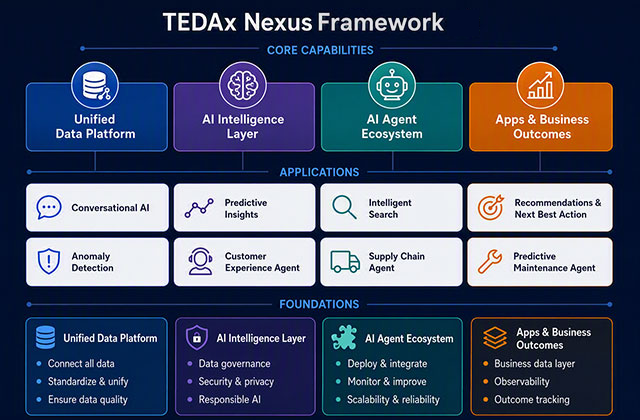
TEDAx Nexus uses a layered architecture to transform data into insights, recommendations, and action. It comprises a data foundation, machine learning layer, and agentic AI layer, as shown in the diagram.
The intelligent data foundation brings together historical and continuously generated data from enterprise systems, customer channels, cloud services, documents, and external sources. It provides the scale and flexibility of an enterprise big data analytics platform. The machine learning layer supports model training, versioning, monitoring, and drift detection. This maintains performance as data and operating conditions change.
The agentic AI layer uses industry and operational information to coordinate analytical tasks. Natural language interaction makes insights and model information accessible. Outputs are delivered through dashboards, portals, mobile applications, APIs, reports, and workflows. Security, quality, monitoring, and reliability extend across the architecture.
Partner


Information Hub
-
How much data can TEDAx handle on a daily basis?
TEDAx processes over 50 terabytes of data daily, handling structured, semi-structured, and unstructured datasets efficiently. It leverages AI-driven optimizations for real-time insights and high-speed analytics, ensuring organizations can scale seamlessly.
-
What kind of performance improvements can businesses expect with TEDAx?
Businesses using TEDAx have experienced:
20% faster operations through AI-driven automation
50% faster issue resolution via anomaly detection and root cause analysis
40% reduction in operational costs by optimizing workflows and eliminating redundancies
-
How does TEDAx improve customer satisfaction and engagement?
By enabling smarter decision-making, predictive analytics, and real-time monitoring, TEDAx has helped organizations achieve:
30% higher engagement through personalized recommendations and automation
25% increase in customer satisfaction by proactively addressing issues before they escalate
-
Can TEDAx manage complex datasets with multiple tables and sources?
Yes,
TEDAx -
Is TEDAx compliant with international data regulations like the EU Data Act?
Absolutely! TEDAx is fully compliant with major international regulations, including:
EU Data Act & GDPR – Ensuring privacy, security, and governance compliance
CCPA & HIPAA – Protecting sensitive personal and healthcare data
SOC 2 & ISO 27001 – Following strict security and risk management protocols
-
Is TEDAx cloud-agnostic and scalable?
Yes, TEDAx is designed for multi-cloud and hybrid environments, seamlessly integrating with AWS, Azure, GCP, and on-premise data centers. Its auto-scaling capabilities ensure businesses can handle spikes in data volume without performance degradation.