


Design-driven Immersive solutions for next-gen transportation experiences
The transportation industry is moving faster than ever. As vehicles become software-defined and digital cockpits transform the in-cabin experience, OEMs are reimagining how new models come to life. Rather than waiting months for physical prototypes, engineering teams are now stepping inside immersive digital twins to explore ergonomics, test ADAS features, and experience HMI behavior in real time, with greater accuracy, speed, and confidence.
With safety expectations rising and development timelines shortening, these visual and spatial computing environments make collaboration feel immediate across various time zones and disciplines. Teams can validate designs earlier, gain AI-powered insights, and make confident, data-driven decisions together. What once demanded multiple prototype builds and extended review cycles now unfolds in shared, real-time environments.
Developing an intuitive VR experience platform


Business Challenges
As vehicle programs grow more complex, balancing strong design validation with manufacturing precision and service readiness is becoming increasingly challenging. Fragmented engineering environments, disconnected data streams, manual validation steps, and increasing workforce skill gaps often lead to delays, rework, and inconsistent execution. Without clear, real-time visibility and alignment across functions, it is difficult for enterprises to scale efficiently, maintain quality standards, and keep pace with rapidly advancing vehicle technologies.


Here’s How We Can Help You
Immersive Vehicle Engineering & Validation
-
Review architectures, subsystems, digital cockpits and intuitive HMIs in real time via VR and web environments for alignment and reviews.
-
Validate ergonomics, accessibility, visibility, packaging and performance using immersive simulations and high-fidelity digital twins to spot early issues.
Virtual Prototyping & Intelligent Manufacturing
-
Build immersive virtual prototypes to reduce physical builds and to improve cost, quality and time-to-market.
-
Simulate factory layouts, assembly sequences and human ergonomics in XR to improve safety, efficiency and production readiness.
Connected Training, Customer Experience & Operational Readiness
-
Deliver repeatable XR-based training for safety, assembly, service and maintenance through interactive, scenario-driven simulations at enterprise scale.
-
Enable product visualization, configurators and virtual walkthroughs, with remote assistance and guided procedures that support post-sales engagement across digital and physical touchpoints.
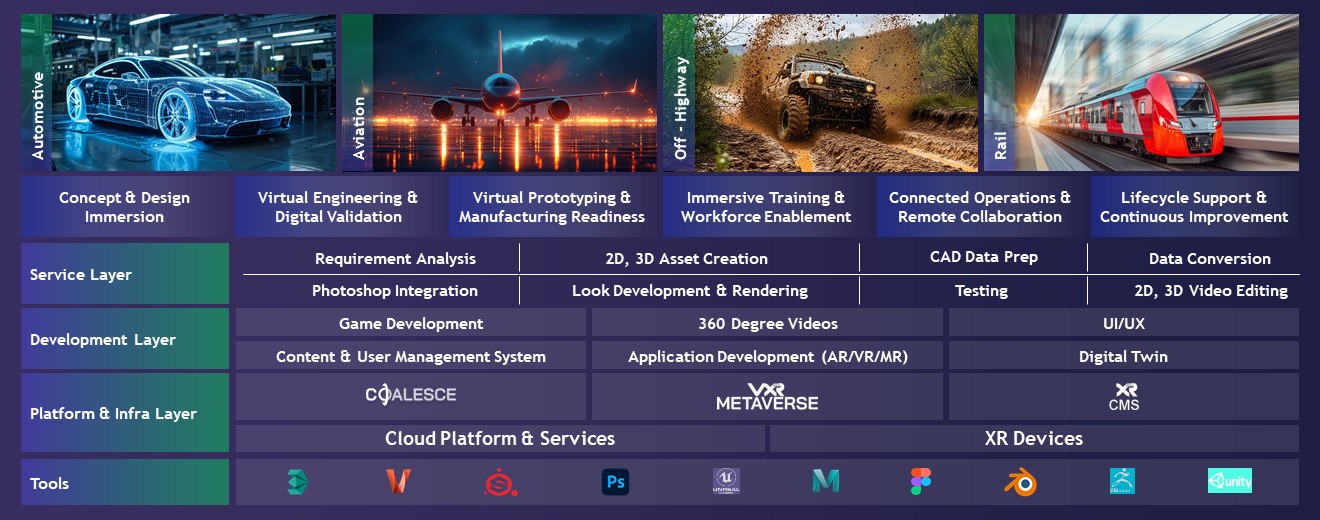
Immersive Framework Across Transportation Value chain
Immersive Design Validation
Enable concept and design immersion through XR-based visualization, 2D/3D asset creation, virtual engineering, structured requirements, testing, and validation—supporting earlier insight, hands-on exploration, and data-driven engineering decisions.
Accelerated Product Readiness
Accelerate product development and manufacturing readiness using reusable assets, CAD data preparation, virtual prototyping, and standardized UI/UX workflows that drive consistent quality, efficiency, and repeatable engineering outcomes.
Unified XR Infrastructure
Deliver cloud-enabled, end-to-end automotive experiences by integrating XR devices, content management, connected operations, and remote collaboration through a unified, scalable platform and infrastructure layer.
Why Tata Elxsi
- Over three decades of engineering and domain expertise across the automotive value chain
- Advanced AI and GenAI capabilities enabling intelligent, adaptive systems and faster development cycles
- Improved design quality, manufacturing readiness, and safer operations through immersive collaboration and training
- Proven proprietary platforms and extensive toolchain expertise delivering a unified, scalable immersive ecosystem
Partners


Information Hub
-
How does XR accelerate early design validation for SDVs and digital cockpits?
XR enables true‑scale reviews of cockpit layouts, HMI flows, and SDV features in immersive digital twins, helping teams validate earlier, catch issues sooner, and reduce costly late rework.
-
Which transportation use cases benefit most from digital twins, simulation, and virtual prototyping?
High‑impact use cases include virtual prototyping, design reviews, packaging and ergonomics validation, manufacturing readiness, serviceability checks, training, and customer walk‑throughs—using digital twins for faster iteration.
-
How can XR support ADAS, HMI, and cockpit UX evaluation in real-time scenarios?
XR simulates realistic driving scenarios to evaluate ADAS alerts, HMI responsiveness, and cockpit UX. Teams can test interactions, visibility, and driver workload safely, using data capture for rapid improvements.
-
How does XR improve manufacturing readiness through factory and ergonomics simulation?
XR enables factory layout and assembly sequence simulations with ergonomic analysis, helping teams validate workflows before launch, reduce line-side changes, improve safety, and accelerate production readiness.
-
How can teams scale XR-based training and remote assistance for service readiness?
XR delivers repeatable, scenario‑based training for service and maintenance, while remote assistance overlays guided steps in real time—enabling consistent onboarding, faster issue resolution, and scalable operational readiness.